
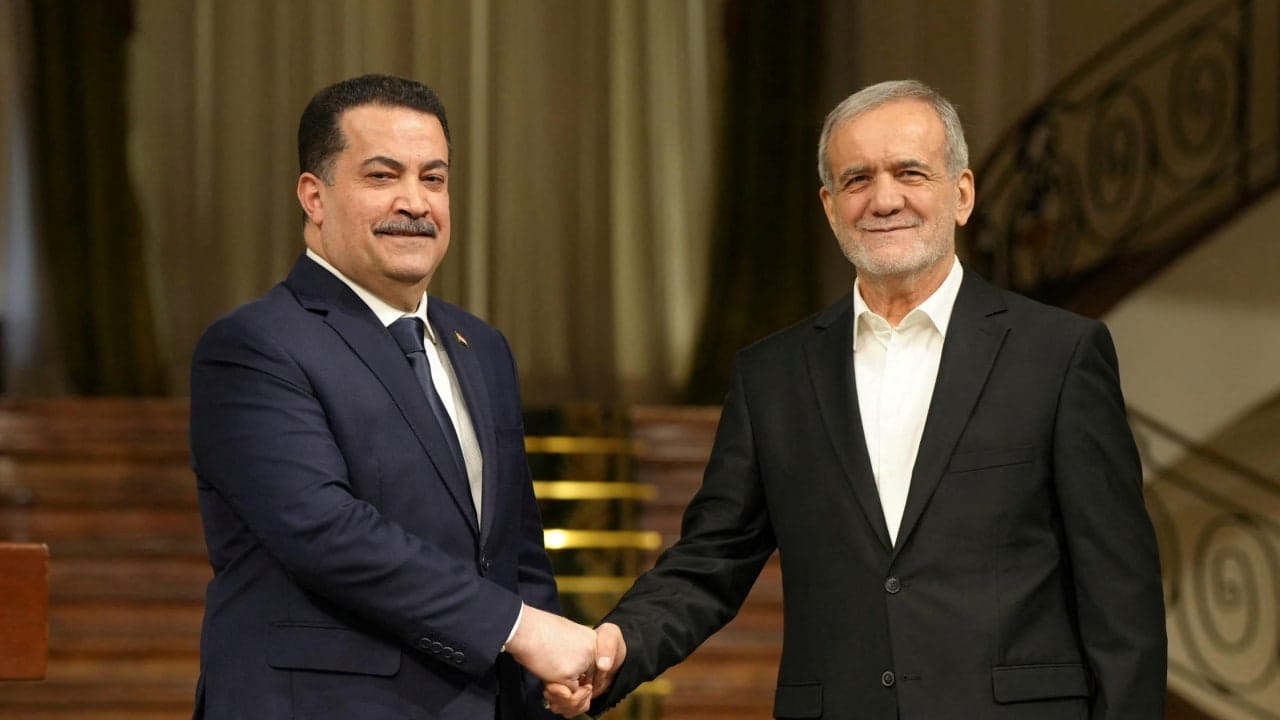
IRAQ’S PRIME MINISTER Mohammed Shia’ al-Sudani (left) meets with Iran’s President Masoud Pezeshkian in Tehran earlier this year. Israeli officials warn that Iranian-controlled Iraqi militias are regaining strength, the writer notes.(photo credit: Iraqi Prime Minister Media Office/Reuters)
If Iran and its proxies are quiet, it is strategic, not surrender.
In recent days, Israeli defense officials have warned that Iraq may be emerging as the next front line, as Iranian-controlled Iraqi militias regain strength after largely sitting out the conflicts of the past two years. This should remind US policymakers to keep Iraq central in their strategic thinking and not view the current war solely through the prism of Gaza.
As Iran rebuilds after severe losses to Israel and renewed American pressure, Tehran is repositioning its “Ring of Fire,” with Iraq and the West Bank taking on expanded roles alongside Lebanon and Gaza.
The return of a Pax Americana to the Middle East has improved US security interests, reassured regional allies, and constrained the influence once exploited by Russia, China, and Iran. Israel, Washington’s key regional partner, has advanced these goals by severely degrading Tehran’s proxy network, long intended to surround Israel and undermine American regional standing.
US and Israeli strikes on critical Iranian infrastructure in June, combined with sustained Israeli blows to Hezbollah and Hamas, have restored a measure of deterrence and signaled that American diplomacy is backed by credible force
By bringing Kazakhstan into the Abraham Accords and extending the framework into Central Asia, directly onto Iran’s doorstep, Jerusalem and Washington risk prompting Tehran to accelerate its destabilization efforts. Iran has a track record of lashing out when it perceives strategic weakness, just as it did in the run-up to October 7, when Israel and Saudi Arabia, with US support, were on the verge of a historic normalization agreement.
Continued volatility in the region
The region remains volatile. Ceasefires in Gaza, Lebanon, and Syria are tenuous. Hamas is rebuilding and further entrenching itself in the West Bank. Although a deconfliction arrangement with Syrian President Ahmed al-Sharaa appears imminent, it is unclear whether he will again rely on jihadist partners once he consolidates power.
Turkey continues its expansionist ambitions, seeking to turn Syria into a satellite and potentially renewing operations against the Kurds. Meanwhile, Iran is restoring its nuclear and missile capabilities and reconstructing its proxies in Lebanon and Gaza. These ceasefires should be regarded as temporary pauses, not peace agreements.
Before October 7, 2023, the West Bank and Iraq were secondary fronts in Iran’s Ring of Fire strategy. After US-brokered ceasefires in Gaza and Lebanon, both have become central as Tehran seeks to reassert regional influence, challenge the United States, and threaten Israel. Iraq is critical to this strategy, especially now that Hezbollah and Hamas have suffered substantial setbacks. While Tehran intends to rebuild these groups, it faces new constraints, as its land corridor that used to deliver advanced weapons to Lebanon has been partially severed.
The world remains focused on Gaza, while the Iranian-backed Hamas presence in the West Bank is dangerously underestimated. French President Emmanuel Macron even claimed Hamas has no foothold there, a statement detached from reality. Iran is likely to intensify operations in the West Bank, both to pressure Israel and destabilize Jordan, a fragile but indispensable American ally providing strategic depth between Israel and Iraq.
Iraq’s parliamentary elections tomorrow will be another critical test. Any US administration seeking regional stability and countering Iranian ambitions must prioritize Iraq. Washington should monitor the vote, blunt Iranian interference, and prevent Tehran’s proxies from further infiltrating Iraq’s military and political institutions.
Although both populations are predominantly Shi’ite, Persians in Iran have long looked down on Arab Iraqis, an internal tension Washington has yet to leverage effectively.
Following the rise of ISIS, Iran inserted its Popular Mobilization Forces into Iraq under the pretext of fighting jihadists. They never left. Folded into the Iraqi army, these militias give Tehran direct influence over Iraq’s security apparatus. Without sustained US counter-efforts, this influence will continue to expand.
For Israel, the strategic landscape is shifting as Iran attempts to resurrect its Ring of Fire, setting the stage for a renewed “war between the wars.” If ceasefires in Gaza and Lebanon hold, Israel and Iran will return to low-intensity, covert confrontation while Tehran rebuilds its networks.
If Iran and its proxies are quiet, it is strategic, not surrender. The most significant shift since October 7 is Israel’s new doctrine: The era of reactive containment is over. Israel now responds preemptively and decisively, even to smaller provocations. Restraint invites escalation; decisive action prevents it.
The regional landscape has shifted in ways that could benefit both the US and Israel, yet major threats remain. Lebanon’s military still refuses or is unable to disarm Hezbollah, forcing Israel to carry out regular strikes to delay rearmament. In Gaza, no international force will disarm Hamas. Even with a technocratic administration in place, Hamas remains dominant, rebuilding tunnels and preparing for future kidnappings to increase leverage.
Israel’s next war between the wars has already begun. Iran will attempt to rebuild its ballistic and nuclear programs while replenishing its proxies. This shadow conflict will feature periodic flare-ups followed by uneasy lulls.
The next moves
What must the United States and Israel do now?
First, anticipate and counter Iran’s next moves. Containment alone emboldens jihadist proxies that interpret restraint as weakness. Israel’s doctrine of preemptive disruption, applied against both existential Iranian threats and immediate border dangers, should remain a guiding principle.
Second, US-Israel coordination must remain tight and strategic. This partnership will be tested after 2028 if a future administration adopts a more cautious or less supportive posture toward Israel’s proactive defense strategy.
Finally, Israelis must resist complacency during calm periods. The lesson of October 7 is clear: Decisive preemption deters aggression, while limited responses invite it. Though counterintuitive to Western audiences, disproportionate responses to Hamas, Iranian and Iraqi militias, or Hezbollah provocations can stabilize the region by restoring deterrence.
The reconstitution of Iran’s Ring of Fire threatens to reverse recent American and Israeli gains. Tehran will continue working to destabilize the Gulf states, Egypt, Jordan, and Israel. Washington must recognize that short of regime change, degrading Iran’s regional power is a core American interest. Only sustained engagement, credible deterrence, and steadfast US-Israel cooperation can prevent Tehran from reigniting its Ring of Fire, and with it, another regional inferno.
This article was originally published in the Jerusalem Post on November 10, 2025.
The writer is director of MEPIN (the Middle East Political Information Network) and the senior security editor of The Jerusalem Report. He regularly briefs members of the US Congress and their foreign policy advisors, as well as officials at the State Department.