
Excluding two states whose governments openly embrace, fund and promote Muslim Brotherhood ideology may make transactional financial sense, but it weakens America’s long-term national-security posture.
Two recent developments in the United States highlight Washington’s ongoing contradiction in dealing with the Muslim Brotherhood.
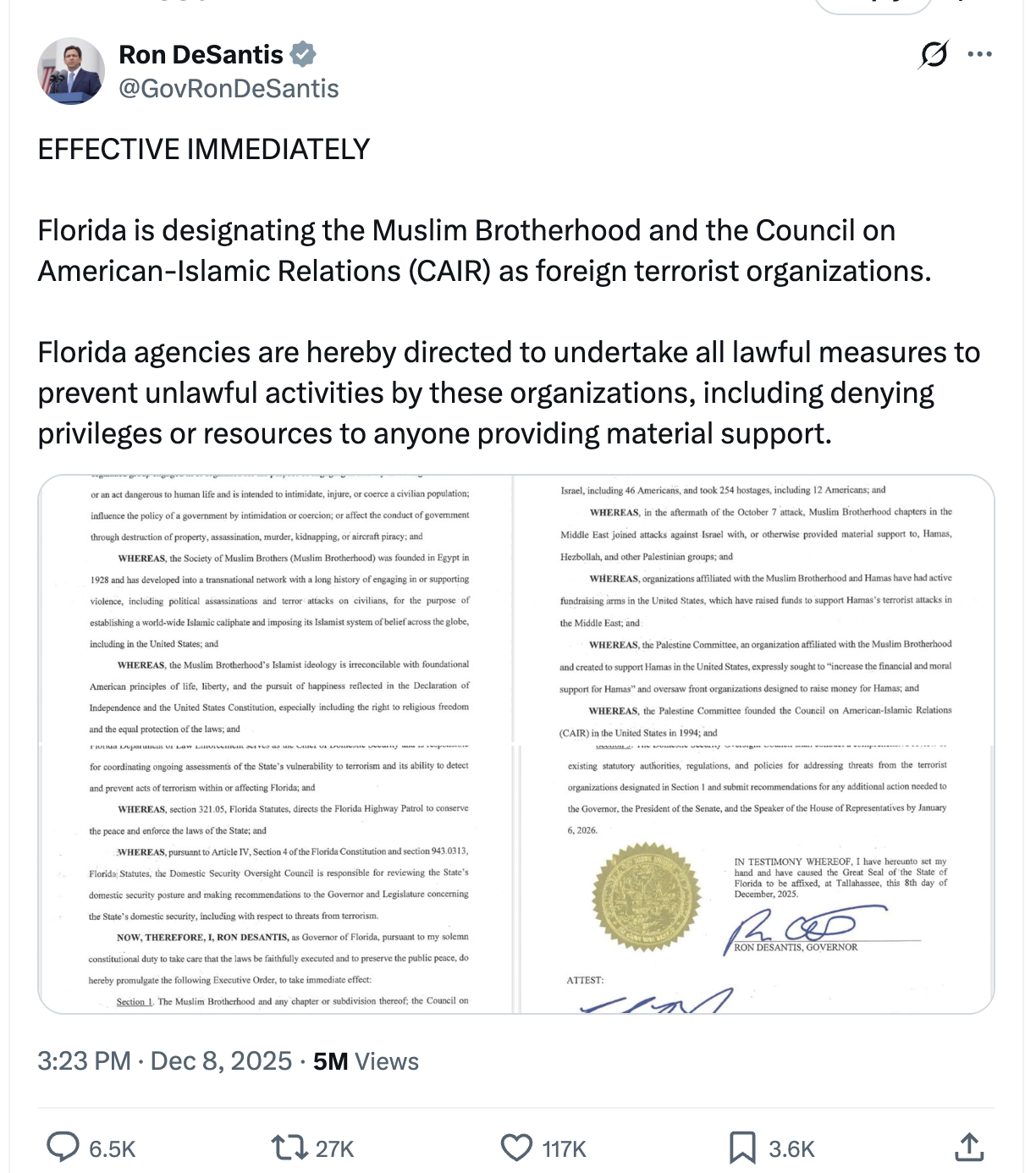
On one side, Gov. Ron DeSantis of Florida and Greg Abbott of Texas, both Republicans, recently took the unprecedented step of designating the Muslim Brotherhood and organizations tied to it, including the Council on American-Islamic Relations (CAIR), as a Foreign Terrorist Organization under their state authorities. Their actions have reignited a national debate that Congress has repeatedly avoided.
In designating these entities as transnational criminal organizations, both governors argued that the Brotherhood has a long record of supporting violence and terror attacks against civilians in pursuit of a global Islamic caliphate, and of promoting Islamist influence worldwide, including within the United States.
In contrast, U.S. President Donald Trump, despite pressure from figures such as Sen. Ted Cruz (R-Texas) to blacklist the Brotherhood in its entirety, adopted a more limited strategy. His administration focused on branches operating in countries aligned with U.S. interests, including Egypt, Saudi Arabia, the United Arab Emirates and Jordan, all of which had already designated the group as a terrorist organization. The result was a partial and often ambiguous framework: Washington condemned certain Brotherhood affiliates while leaving unaddressed its most influential state backers, in particular, Qatar and Turkey.
Democrats, for their part, have largely opposed designating the Brotherhood at all, often out of concern that doing so would invite accusations of Islamophobia or amount to criminalizing an ideology.
Is it an ideology? A political movement? A network that inspires both political parties and terrorist organizations? In reality, it is all of the above.
Hamas’s charter leaves no ambiguity: It identifies itself as part of the Muslim Brotherhood and frames its mission around a radical vision that blends Islamist supremacy, antisemitism and total hostility toward non-believers. Other Brotherhood-inspired entities, such as ISIS, Al-Qaeda and a range of Sunni extremist groups, adopt the Brotherhood’s worldview in the form of violent militancy.
What Western policymakers fail to grasp is that the Brotherhood operates along a spectrum, ranging from political to violent, but its long-term objectives remain consistent.
When the West examines Brotherhood-aligned states such as Turkey and Qatar, it often accepts the argument that these regimes are engaged in “political Islam,” not violent extremism. Yet this is a dangerous misconception. Qatar funds and shelters radical organizations linked to the Brotherhood, including Hamas and elements of Al-Qaeda, while simultaneously promoting educational and cultural initiatives (such as the Qatar Foundation) that export Brotherhood ideology into Western universities and even K-12 classrooms.
About 15 years ago, I spoke with a member of Congress who had allowed CAIR, a Muslim Brotherhood-inspired organization, access to staff and to volunteer in her office. When I warned her that CAIR was Islamist-aligned and aggressively anti-Israel, she responded that could be bordering on Islamophobia.
I replied that opposing radical Islamist groups is no more “anti-Islam” than opposing the Ku Klux Klan in a congressional office is “anti-Christian.” Muslims themselves are targeted by Islamist movements when they reject extremism or seek coexistence with Israel or the West.
The United States can designate the Brotherhood as a Foreign Terrorist Organization, but doing so selectively makes little strategic sense. If Qatar did not possess trillions of dollars in natural-resource wealth, no Western nation would tolerate its systematic promotion of radical Islamist ideology. Qatar, a country of barely 300,000 citizens, wields disproportionate influence by funding universities, media outlets, political relationships and charitable fronts that spread Brotherhood ideology globally while simultaneously supporting violent actors with American blood on their hands.
DeSantis and Abbott deserve credit for doing what Congress has avoided for decades: formally labeling the Brotherhood a terrorist organization and publicly calling out CAIR as part of that network.
Mr. President, you correctly identified the Muslim Brotherhood as dangerous and took steps to address some of its branches. But excluding Qatar and Turkey—two states whose governments openly embrace, fund and promote Muslim Brotherhood ideology—undermines the effort. It may make transactional financial sense, but it weakens America’s long-term national-security posture.
In my assessment, the United States holds substantial leverage over Qatar but has chosen not to use it. Doha views the U.S. Al Udeid Air Base as indispensable not only to Washington’s regional interest but to Qatar’s own security. If Qatar were made to believe that its Gulf State rival, the United Arab Emirates, was prepared to host and even finance an upgraded U.S. facility capable of matching or surpassing Al Udeid, I believe that Doha would move quickly to the negotiating table.
Qatar depends on the American military presence to deter Iran, with which it shares the world’s largest natural-gas field. Under meaningful pressure, it could be compelled to recalibrate its ties to the Brotherhood, as well as rein in the anti-American and anti-Israel rhetoric often associated with its Al Jazeera media network.
For now, however, Qatar continues to punch well above its weight, benefiting from the protection afforded by U.S. security commitments while simultaneously pursuing policies that undercut American and broader Western interests.
If the Muslim Brotherhood is to be confronted seriously, the United States must address not only its violent manifestations but also the state actors who protect and promote its ideology.
Dr. Eric R. Mandel is the director of MEPIN, the Middle East Political Information Network, and the senior security editor of The Jerusalem Report. He briefs members of Congress, their foreign-policy teams, and the U.S. State Department on Middle East security and strategy.