
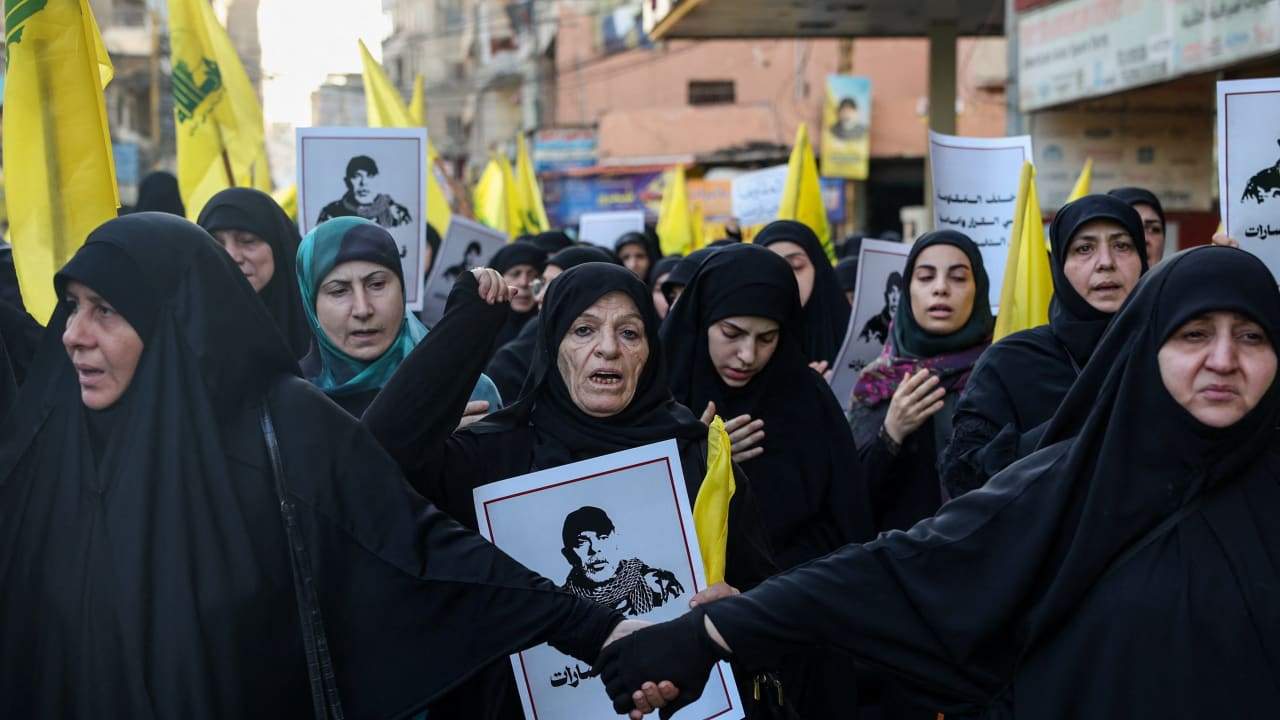
PEOPLE GATHER to attend the funeral of top Hezbollah military official Haytham Ali Tabatabai and others killed in an Israeli airstrike in Beirut’s southern suburbs last week. Hezbollah remains the dominant force in Lebanon, says the writer.(photo credit: MOHAMED AZAKIR/REUTERS)
The ceasefire is unsustainable. Lebanon’s government and armed forces are unwilling and unable to confront Hezbollah, making enforcement impossible.
On the first anniversary of the American-mediated Lebanese-Israeli ceasefire, its prognosis is grim, and it remains on life support. Lebanon’s government and armed forces lack both the will and the ability to confront Hezbollah, which operates as a parallel authority inside the state. Without the Lebanese Armed Forces’ (LAF) credible enforcement, the ceasefire is little more than a temporary pause, not a path to durable peace.
The Trump administration appears to understand this, allowing Israel to enforce the ceasefire directly, with over 1,200 Israeli strikes, as the American-designated terrorist group continually tries to rebuild its infrastructure and weapons manufacturing. Hezbollah had hoped US President Donald Trump would lose patience with Israel’s ongoing operations as it attempted to rearm and reposition itself in southern Lebanon.
UN Security Council Resolutions 1559 and 1701 require Hezbollah to disarm not only in southern Lebanon but throughout the country. For decades, the terror group has functioned as a state-within-a-state, offering social services to the Shi’ite community while indoctrinating it with Iran’s radical Islamist ideology. It finances itself through money laundering, drug trafficking, and a steady stream of cash from Tehran, serving as Iran’s most valuable proxy.
According to a Wall Street Journal investigative report, Hezbollah’s principal patron, Iran, is funneling hundreds of millions of dollars through UAE “money exchanges to rebuild its battered ally.”
Hezbollah remains dominant force
Washington and Jerusalem hoped that with Iran and Hezbollah weakened by Israeli strikes and the fall of the Assad regime, eliminating another Iranian client, Beirut might finally assert control. Instead, Hezbollah remains the dominant force in the country.
Roughly half of Lebanon’s population is Shi’ite, as are an estimated 40% of LAF personnel, a significant number of whom operate under Hezbollah influence. Even with $150 million in annual US support, the LAF remains underfunded, politically constrained, and incapable of challenging Hezbollah.
Like Hamas and the Iranian regime, Hezbollah routinely violates agreements and manipulates Western sensitivities around civilian casualties by embedding its arsenal in densely populated areas. The Trump administration, unlike its predecessors, used credible military force to damage Iran’s nuclear infrastructure while giving Israel broad latitude to target Hezbollah in Lebanon and Hamas in Gaza despite Hezbollah’s strategy of storing weapons in civilian homes.
According to the Alma Research Center, where I serve on the international advisory board, “every third house” in Shi’ite villages in southern Lebanon is used for Hezbollah military purposes: storage, tunnels, and launchpads. Alma’s legal expert, Yifa Segal, explains that Hezbollah intentionally embeds in civilian areas to maximize collateral damage and then portrays Israeli defensive strikes as war crimes.
During the Syrian civil war, a Lebanese doctor overseeing medical care for Syrian refugees told me that in the 300 southern Lebanese villages he visited, “not one” lacked missiles or weapons stored inside civilian homes. Fox News similarly reported that Hezbollah’s Rabat unit coordinates with property owners to identify homes “suitable to serve the human shield tactic.”
Disarmament unlikely
Hezbollah has rejected the possibility of disarmament. Secretary-General Naim Qassem said, “We will not let anyone disarm Hezbollah… We must cut this idea of disarmament from the dictionary.” The LAF refuses to enter civilian homes to seize weapons, making government promises of disarmament meaningless.
Lebanese leaders fear that confronting the terror group would invite accusations of collaborating with Israel and risk another civil war, a trauma that has defined Lebanon’s modern history.
Rebuilding the country while Hezbollah holds de facto authority is both unrealistic and counterproductive, as it would strengthen the group’s political and social grip by positioning it as the conduit for international aid. Reconstruction should therefore focus only on areas outside the group’s control. As in Gaza, no international force is willing or prepared to confront Hezbollah or enforce a ceasefire.
In August 2025, Lebanon’s cabinet instructed the LAF to produce a plan to bring all weapons under “legitimate government oversight” by year’s end. President Joseph Aoun declared that all arms must come under “exclusive state control.” Hezbollah immediately dismissed the idea, warning that “any hand that reaches out to take them will be cut off.” Aoun quickly retreated, insisting disarmament must occur only through dialogue to avoid civil war.
Good luck with that.
Ceasefire is unsustainable
The alternative, UNIFIL (the UN Interim Force in Lebanon), has been a failure since 2006. The peacekeepers have repeatedly interfered with Israeli operations against Hezbollah while stopping the transfer of exactly zero missiles. Its mandate will end in 2026, only because the United States finally refused to fund an ineffectual mission.
The ceasefire is unsustainable. Lebanon’s government and armed forces are unwilling and unable to confront Hezbollah, making enforcement impossible. The Trump administration should treat the ceasefire as a short-term management tool, not a foundation for lasting peace.
As the Alma Research Center concluded, Hezbollah’s core identity is “armed resistance” against Israel, an ideology it cannot relinquish. The terror group will not give up the ideology of armed resistance, and it is prepared for a long struggle. Israel’s strategy must therefore match this, demonstrating endurance, determination, and persistence. Long-term weakening of the organization will be possible only through continuous damage to its military and civilian infrastructures.
This article appeared in the Jerusalem Post on Nov. 30, 2025
The writer is the director of MEPIN, the Middle East Political Information Network, and the senior security editor of The Jerusalem Report. He regularly briefs members of Congress and their foreign policy advisers, as well as the State Department.