
By Lt. Col. (Res.) Avi Shalev, author of “The Only Jew in the Room“
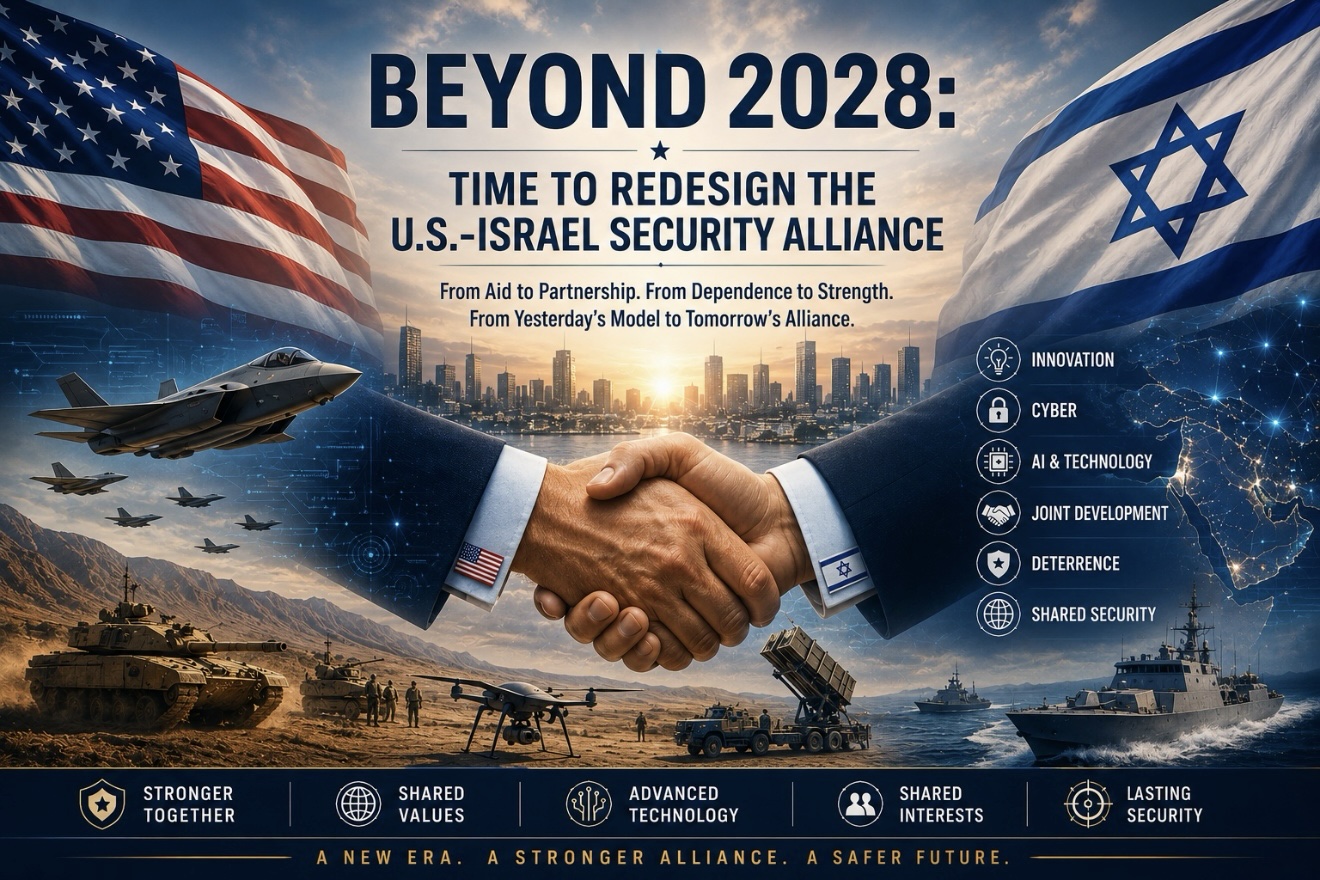
Israel should become the first nation to voluntarily seek an end to American military assistance – not because the alliance with the United States has weakened, but precisely because it has matured. More than seven decades after Israel’s founding and over fifty years after Washington became its principal strategic partner, the relationship has reached a point where it should no longer be defined primarily by financial assistance. Instead, it should evolve into a partnership between two military and technological powers that share common interests, values, and strategic responsibilities.
The October 7, 2023 attack and the regional wars that followed transformed far more than the security landscape of the Middle East. They accelerated political, demographic, economic, and ideological trends within the United States that are likely to reshape the strategic environment in which the U.S. – Israel alliance operates. Although military cooperation between the two countries reached an unprecedented level during the Second Iran War in 2026, when American and Israeli forces fought in close operational coordination against Iran, that same conflict may ultimately be remembered as the beginning of a new era rather than the culmination of the old one.
The subsequent U.S. – Iran Memorandum of Understanding illustrated an important strategic reality: even the closest allies may choose different paths when their national interests evolve. This should not be interpreted as evidence of a weakening alliance but as a reminder that every alliance must continually adapt to changing geopolitical circumstances.
At the same time, profound domestic changes are taking place within the United States. The election of Zohran Mamdani as Mayor of New York City, the growing influence of progressive voices within the Democratic Party, and the parallel rise of isolationist tendencies among segments of the Republican Party are not isolated political events. They are symptoms of deeper structural transformations. Mounting national debt, demographic change, declining trust in traditional institutions, and growing skepticism toward America’s global commitments are gradually reshaping the political consensus that has supported U.S. foreign policy for decades.
For Israel, these developments carry important implications. The current Memorandum of Understanding governing American military assistance expires in 2028. While there is no certainty that U.S. military aid will end, neither can Israel assume that it will automatically continue under its existing framework. Building Israel’s long-term national security strategy on the assumption that American assistance will remain unchanged indefinitely would therefore be strategically irresponsible.
Yet what appears to be a challenge may also represent an historic opportunity.
For more than half a century, American military assistance has been one of the greatest strategic investments ever made by the United States. It enabled Israel to preserve its qualitative military edge, accelerated the development of its defense industries, strengthened intelligence cooperation, and reinforced one of the most successful strategic alliances of the modern era.
Its success is beyond dispute. Precisely because it has succeeded, however, it is time to move beyond it.
Rather than investing political capital in preserving an assistance model that is becoming increasingly controversial inside American politics, Israel should become the first ally to propose a different model altogether. Instead of another decade of military aid, Jerusalem should invite Washington to negotiate a new strategic framework built upon joint technological leadership, shared industrial capacity, collaborative research and development, integrated defense production, and common strategic planning.
Such an initiative would not weaken the alliance. It would modernize it.
Israel in 2028 bears little resemblance to the country that first began receiving substantial American assistance after the Yom Kippur War. Nor is it the Israel of the late 1990s, when the current architecture of military aid was largely shaped. Today, Israel is a regional military power, a global leader in cyber security, missile defense, artificial intelligence, precision weapons, autonomous systems, and defense innovation. It possesses one of the world’s most sophisticated intelligence communities and has become an indispensable laboratory for operational military technologies.
In many fields, Israel now contributes to America’s technological advantage no less than it benefits from it. A new strategic framework would therefore serve both countries.
For Israel, it would reinforce strategic independence while preserving – and even strengthening – the alliance with Washington. For the United States, it would remove military assistance from an increasingly polarized domestic political debate and redirect bilateral cooperation toward areas that enjoy far broader bipartisan support: technological superiority, defense innovation, industrial resilience, intelligence cooperation, joint deterrence against common adversaries, and maintaining the military advantage of the democratic world.
The objective should therefore be clear: Israel should become the first American ally to voluntarily transition from an aid-based relationship to one founded upon strategic reciprocity. That transformation, however, cannot remain merely declarative. It must be translated into concrete policy.
From Dependency to Strategic Partnership
The first step should be to initiate discussions with Washington well before the current Memorandum of Understanding expires in 2028. Rather than approaching the negotiations with the objective of renewing military assistance under familiar terms, Israel should propose an entirely different framework—one that reflects the strategic realities of the twenty-first century.
Instead of defining the relationship through annual financial transfers, the two governments should negotiate a comprehensive strategic partnership centered on joint investment in defense innovation, collaborative research and development, integrated production lines, intelligence cooperation, and long-term force development. Such an agreement would recognize that both countries possess unique capabilities that reinforce one another. The objective would no longer be a relationship between donor and recipient, but between two allies jointly investing in their shared security.
This would also reduce the political burden associated with foreign aid inside the United States while simultaneously expanding cooperation in areas where bipartisan consensus remains strong. Rather than debating how much money Washington should provide Jerusalem each year, both governments would focus on maintaining their collective technological and military advantage over common adversaries.
Preparing for the Next Revolution in Warfare
The changing character of war also requires Israel to rethink its own force-building priorities.
The wars of the past decade have demonstrated that future battlefields will be increasingly dominated by autonomous systems, artificial intelligence, inexpensive precision weapons, distributed combat networks, electronic warfare, and mass-produced unmanned platforms operating simultaneously across land, sea, air, and cyberspace.
Israel should therefore gradually reduce its dependence on exceptionally expensive imported platforms wherever practical, while dramatically expanding domestic investment in the technologies that are likely to dominate future conflicts. These include drones, loitering munitions, autonomous ground systems, unmanned naval platforms, AI-enabled decision support, long-range precision strike capabilities, autonomous swarming technologies, and resilient communications networks.
This is not an argument against advanced American platforms such as the F-35, which will continue to play an essential role in Israel’s deterrence posture. Rather, it is an argument for ensuring that future procurement reflects the changing economics of modern warfare. Military superiority will increasingly depend not only on the quality of individual platforms but also on the ability to deploy large numbers of intelligent, affordable, and highly survivable systems. Israel is uniquely positioned to lead that transformation.
Making Israel an Indispensable American Strategic Asset
A mature alliance should also reshape the geography of defense cooperation. Instead of remaining primarily a purchaser of American defense products, Israel should become Washington’s principal regional hub for research, testing, production, maintenance, and operational evaluation of advanced military technologies.
This could involve expanding the American industrial and defense presence in Israel through joint innovation centers, integrated manufacturing facilities, emergency logistics hubs, strategic stockpiles, and shared technological infrastructure. Designated free-trade zones or specially regulated (or extraterritorial) areas (like industrial, air or seaports) could facilitate such cooperation while encouraging long-term American investment.
Such a framework would strengthen not only Israel’s economy but also America’s strategic posture throughout the Eastern Mediterranean and the broader Middle East. At a time when instability continues to characterize much of the region, Israel offers the United States something increasingly valuable: secure zones, political stability, technological sophistication, operational experience, and reliable strategic access.
Rather than being viewed primarily as a recipient of American assistance, Israel would increasingly become an indispensable contributor to American power projection and regional deterrence.
Strengthening National Resilience
Strategic independence requires more than military capability. It also depends upon national resilience.
Israel should therefore continue expanding protected underground infrastructure for both civilian and military purposes while diversifying its defense industrial base. Greater emphasis should be placed on encouraging innovative small and medium-sized technology companies rather than concentrating procurement among a limited number of large contractors. Competition and innovation have long been among Israel’s greatest strategic advantages and should remain central to its future force development.
Financial resilience deserves equal attention.
As global financial uncertainty increases, Israel should reassess the composition of its foreign-exchange reserves. Greater diversification – including a larger allocation to gold alongside existing reserve assets – would strengthen long-term strategic flexibility without undermining the close economic relationship between Jerusalem and Washington.
Military resilience, industrial resilience, technological resilience, and financial resilience together form the foundation of genuine strategic autonomy.
A Complementary Diplomatic Initiative
Strategic autonomy cannot be measured solely by military strength. Great powers are judged not only by their ability to win wars, but also by their ability to shape the political order that follows them. Military victories that are not translated into sustainable political achievements often erode over time, requiring repeated military campaigns to preserve the status quo.
For that reason, Israel’s transition toward greater strategic independence must be accompanied by greater diplomatic initiative. A nation that seeks to become a more equal strategic partner of the United States must also demonstrate the ability to shape its own regional environment rather than merely respond to the initiatives of others.
This is why the diplomatic dimension is an integral part of the broader strategic vision presented in this paper. Israel should place on the table a realistic political framework capable of consolidating the achievements of its military campaigns. Such an initiative should not be viewed as a concession but as an instrument of strategy—one designed to translate military success into long-term security.
In Gaza, Israel should promote a new framework under which responsibility for civilian administration and security would gradually be transferred to an international governing mechanism while severing Israel’s remaining civilian responsibilities toward the Strip. Such an arrangement would reinforce the strategic objective of ending the structural dependency that has characterized Israeli-Gazan relations for decades.
In Judea and Samaria, Israel should pursue long-term interim arrangements based on clearly defined security benchmarks rather than artificial political timetables. Any future political progress must be conditioned upon measurable and verifiable performance in areas that have long been regarded as fundamental to Israeli security: dismantling terrorist infrastructure, ending incitement, reforming educational systems that encourage extremism, establishing effective security cooperation, and creating reliable mechanisms for monitoring compliance.
Similarly, Israel should seek a comprehensive peace agreement with Lebanon, provided that such an agreement is conditioned upon the complete disarmament of terrorist organizations operating within Lebanese territory. Diplomatic normalization cannot coexist indefinitely with heavily armed non-state actors whose declared objective remains Israel’s destruction.
Finally, Israel should deepen its strategic partnerships with Christian communities throughout the Land of Israel and the region while expanding its long-standing alliance with the Druze community into the broader Syrian arena wherever regional conditions permit. Strengthening these relationships would not only contribute to regional stability but would also reinforce Israel’s historic ties with pro-Israel Christian communities in the United States—an increasingly important strategic constituency.
Israel should not allow others to define the region’s political future while it merely reacts. Strategic maturity requires the ability to formulate realistic diplomatic initiatives that emerge from Israel’s own security interests and national objectives. As Israel assumes greater responsibility for its own security, it must also assume greater responsibility for shaping the political environment in which that security will be sustained.
Military strength, strategic independence, and diplomatic initiative are therefore not separate policies. They are three pillars of a single national strategy.
Conclusion
The alliance between Israel and the United States remains the most important strategic asset either country possesses in the Middle East. Precisely because of its importance, however, it should not remain frozen within a framework designed for a very different geopolitical era.
The expiration of the current Memorandum of Understanding in 2028 presents not merely a negotiating deadline but an opportunity to redefine the relationship on stronger and more sustainable foundations.
Replacing military assistance with strategic partnership would not diminish the alliance. On the contrary, it would acknowledge the remarkable success of American policy over the past half-century. The ultimate measure of successful assistance is not its permanence but its ability to produce a partner capable of standing on its own while contributing even more to the shared alliance.
Such a transformation would strengthen both countries.
For Israel, it would encourage greater strategic self-reliance, technological innovation, industrial resilience, and diplomatic initiative. For the United States, it would reinforce one of its most capable allies while reducing the political controversies surrounding foreign military assistance and expanding cooperation in areas of enduring bipartisan support.
History demonstrates that successful alliances evolve rather than remain static. The U.S.-Israel alliance has now reached such a moment.
The question is no longer whether the alliance will endure. It almost certainly will.
The real question is what kind of alliance it will become.
If Israel takes the initiative before changing political realities impose it, the alliance can emerge stronger, more balanced, and better suited to the strategic challenges of the twenty-first century. The objective should not be to preserve yesterday’s framework, but to build tomorrow’s partnership.