
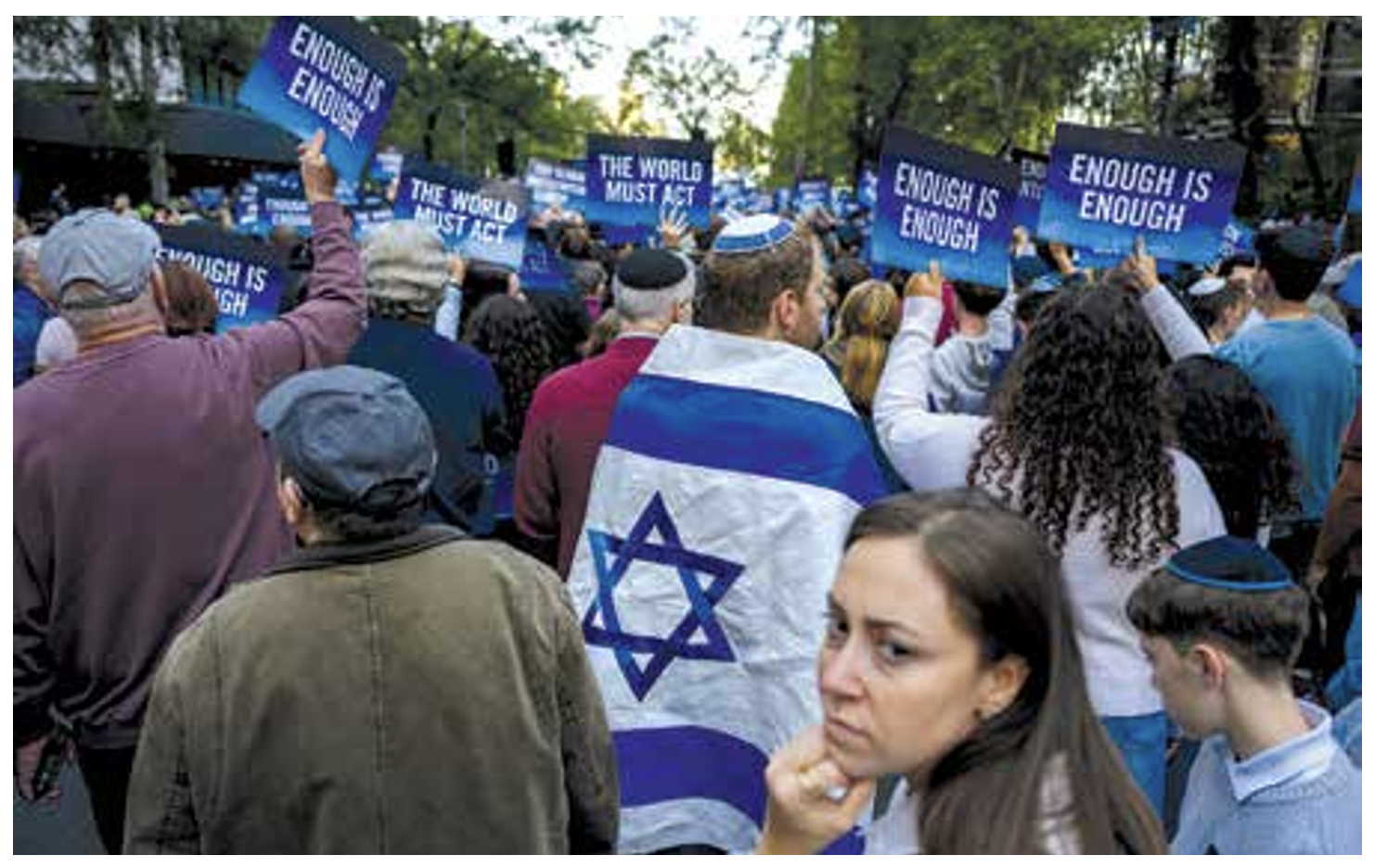
Jewish students have raised concerns about antisemitism and exclusion on American campuses, as debates over Israel increasingly affect Jewish life in the US. Photo credit: Alexi J. Rosenfeld/Getty Images
Are the midterm elections the death knell for US-Israel relations and American Jewry?
American Jewry is under siege. The warning signs have been building for years, but October 7, 2023, marked a turning point.
Since then, American Jews have increasingly faced hostility on college campuses, in professional circles, newsrooms, corporate boardrooms, and their own communities.
Too often, they are held collectively responsible for allegations of genocide, settler colonialism, and apartheid simply because they support the existence of a Jewish state, a position embraced by the overwhelming majority of American Jews.
The midterm election results threaten to worsen an already dangerous environment.
Jewish Americans, particularly those visibly identifying as Jewish through a kippah or Star of David, may face increasing hostility and intimidation. Antisemitism is also penetrating institutions once associated with intellectual openness and tolerance.
Jewish professionals are increasingly concerned about exclusion from publishing, media, and academia, particularly when pressured to disavow Zionism to gain acceptance. These developments reflect a broader challenge to American Jews’ ability to participate openly and confidently in American life.
A fraying alliance
For Israel, the consequences could be equally profound. Its qualitative military edge (QME), the technological and operational superiority that enables a small nation surrounded by adversaries with vastly greater resources to defend itself, has long been a cornerstone of American policy.
Although Congress codified QME protections into law in 2008, the political commitment sustaining them could weaken under a new Congress increasingly resistant to any military assistance for Israel.
The latest shock came on Election Day, when US President Donald Trump announced that the United States would end the approximately $3.8 billion in annual military assistance to Israel after 2026, two years before the current memorandum of understanding expires.
The announcement raises fundamental questions about the future of American support. Ironically, the $38 billion agreement was negotiated during the Obama administration, despite frequent disagreements with Prime Minister Benjamin Netanyahu.
It reflected an understanding that the strategic partnership transcended individual presidents and their political differences.
Will Trump remain steadfast in his support for Israel, or will political pressure lead him to reconsider this relationship?
The emerging Republican isolationist movement, personified by Tucker Carlson and the increasingly influential antisemitic faction associated with Nick Fuentes, sees the election as an opportunity to reshape the Republican Party.
These voices have long questioned why America should support Israel. The Republican electoral setback could strengthen their efforts to dismantle traditional foreign policy commitments.
Trump may also seek scapegoats for the defeat and find political expedience in distancing himself from Israel. Netanyahu has become a convenient target, particularly among Democrats, many of whom believe Israel drew the US into the war with Iran.
Whether justified or not, that perception carries political consequences.
Netanyahu’s decision to tie Israel’s fortunes so closely to Trump demonstrated a troubling lack of strategic foresight. By prioritizing one president over the bipartisan relationship Israel had cultivated for decades, he potentially handicapped future Israeli leaders in their dealings with Democrats.
Last spring, I urged Knesset members to reach out to Democratic leaders before the midterms, warning that waiting until after a Democratic electoral wave would be too late. Unfortunately, that warning now seems increasingly relevant.
Progressive anti-Israel Democrats are celebrating the results.
Their objectives extend beyond criticizing Israeli government policies to ending military assistance, imposing sanctions, restricting diplomatic protection, and pursuing Israel through international institutions, including the International Court of Justice, the International Criminal Court, and the United Nations Security Council.
The question is whether a future American president will continue protecting Israel from international proceedings many Americans consider politicized.
For American Jews who care deeply about Israel, the immediate challenge is to resist further isolation and intimidation. We must distinguish legitimate criticism of Israeli policies from the delegitimization of Israel itself.
American Jews should never have to accept that Israel’s existence as a Jewish state is illegitimate or that supporting its right to exist makes them responsible for every action of its government. Appeasing antisemitism has never worked.
We must also distinguish between vocal, organized factions and the millions of Americans who are neither antisemitic nor reflexively anti-Israel.
Before October 7, surveys already indicated that a significant minority held anti-Jewish attitudes. I shudder to think what the polls might reveal today after the alarming surge in anti-Jewish rhetoric and conspiracy theories throughout the election season.
Nevertheless, I believe most Americans still recognize Israel’s right to exist as a Jewish state. The challenge is ensuring this majority speaks up, rather than letting a vocal minority dominate the national conversation.
American Jews must remain proud, visible, and unapologetic. They should defend Israel’s right to exist without feeling obligated to endorse every Israeli government policy. They must also explain why Israel matters to American national security and why the relationship serves American interests.
I am particularly concerned about Jewish college students, who may be among the first to re-experience the consequences of the growing political acceptance and electoral success of candidates who espouse or tolerate antisemitism.
On campuses, agitators, including Islamist extremists and elements of the progressive movement, have created environments where Jewish students are intimidated, excluded, and made to feel that identifying openly as Zionist is incompatible with belonging.
Too many university administrators and faculty members have failed to distinguish legitimate political protest from the harassment of Jewish students, even after Congressional hearings post October 7.
Israel’s strategic response
Israel must prepare for a future without direct American military assistance. Trump’s announcement should be treated as a strategic warning, not merely a temporary political setback. Israel’s military planners, intelligence officials, and defense industries must immediately prepare for a new reality.
I have long supported making the next memorandum of understanding the last in its current form.
The goal should be a full strategic partnership based on shared interests, intelligence cooperation, advanced technology, joint research, and mutually beneficial defense production, not dependence on American financial assistance.
This transition must be gradual to protect Israel’s military readiness. But preparations must begin now. The slow off-ramp may have ended.
Lost in the political panic is a fundamental truth: America needs Israel, too. Israel is not simply a recipient of American assistance; it is a strategic asset. The US benefits from Israeli intelligence, battlefield experience, military research, weapons testing, and technological innovation.
Israel is among America’s most capable regional partners, a vibrant democracy, and a leader in technologies essential to American economic and national security.
Unlike American commitments in Germany, Japan, and South Korea, the US-Israel partnership does not require permanently stationed American combat troops.
Israel must explain this relationship to a new generation of American policymakers in terms of mutual strategic advantage, not historical sentiment alone.
Rebuilding political ties
Netanyahu and the Israeli opposition should consider forming a national unity government to establish a genuine national consensus on relations with Washington. Israel cannot afford to have its American policy dictated by the electoral interests of one prime minister or coalition.
A unity government will not automatically transform Democratic attitudes, nor will changing prime ministers alone resolve the problem. But a broader governing consensus would demonstrate that Israel’s relationship with America is a national strategic interest, not a partisan political instrument.
Israel must also rebuild relationships with Democrats, Republicans, younger Americans, and policymakers reconsidering traditional foreign policy commitments. It cannot afford to be identified exclusively with one party or political personality.
The next American administration, regardless of party, must understand that abandoning Israel would damage American interests as well as Israeli security.
Are the midterm elections the death knell for US-Israel relations and American Jewry? I hope not. But they may mark the beginning of the most consequential realignment in the relationship since its modern foundations were established.
American Jews deserve to feel safe identifying openly as Jews, and Americans deserve a serious debate about why Israel remains a friend rather than the cause of America’s problems. Yet I fear we have not reached the darkest point of this political realignment.
The danger is not simply that America may abandon Israel. It is that American Jews may increasingly discover that their support for the Jewish state is being used to question their own place in American society. That threatens American Jewry, the US-Israel alliance, and ultimately the values of the United States itself.
We cannot afford to wait and see what happens next.
This article appeared in the November 30, 2026 edition of the Jerusalem Report.
The writer is the director of MEPIN, the Middle East Political Information Network, and is the senior security editor of the Jerusalem Report. He briefs members of Congress and their foreign policy advisors, as well as the State Department.