
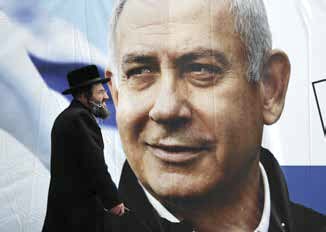
Prime Minister Benjamin Netanyahu’s long career has depended on the support of ultra-Orthodox parties, which have extracted disproportionate benefits in exchange for coalition loyalty. Thomas Coex/AFP via Getty Images
Allowing ultra-Orthodox Jews to refrain from sharing the burden of IDF service is unsustainable and existentially dangerous
When Diaspora Jews think about Israel’s security threats, their minds immediately turn to Iran, Gaza, Lebanon, Syria, Turkey, the West Bank, and a hostile international community. Yet one of Israel’s greatest long-term challenges lies not beyond its borders, but within them.
The secret ingredient behind Israel’s 77 years of survival has been national unity, cohesion, and resilience. For most Israelis, the state is not merely a country – it is family. It embodies a shared vision of a people returning to their ancient homeland after millennia of exile and persecution.
But there is a significant segment of Israeli society that does not share this vision or
feel invested in the Zionist project. Many in this group benefit from the state’s prosperity and protection while remaining insulated from broader society, declining to contribute to the nation’s defense or economic vitality.
It is understandable that Israel’s 20 percent Arab minority, many with familial ties to Palestinians in the West Bank, may not feel comfortable singing Israel’s national anthem. But the more troubling challenge comes from a growing segment within the Jewish majority itself: the ultra-Orthodox, or Haredim. The issue of Haredi enlistment strikes at the very core of Israel’s social contract.
Complex community
The ultra-Orthodox should not be painted with a single brush. A small but growing number seek to serve in the IDF or contribute to national life.
On a recent visit to a new -Orthodox combat unit in the Jordan River Valley – the Hasmonean Brigade, created to accommodate Haredi soldiers – I met men who proudly wore an army uniform. Their courage and idealism were inspiring. Yet they remain the exception.
The overwhelming majority of Haredim do not support Zionism, the Jewish state, or military service. They often reject basic secular education, leaving them unable to participate meaningfully in Israel’s modern economy. Many secular and religious Zionist Israelis who pay high taxes, serve in the IDF, and send multiple family members to combat, view this with growing resentment.
The roots of this issue go back to the founding of the state, when David Ben-Gurion exempted approximately 400 Torah scholars from military service. He believed the insular ultra-Orthodox world would gradually fade in modern Israel.
Instead, the opposite occurred. Today, Haredim make up about 13 percent of Israelis and have one of the highest birth rates in the developed world. The Israel Democracy Institute estimates they will reach 25 percent by 2065.
These exemptions are now institutionalized, producing a class of men who neither serve in the army nor participate in the workforce. The result is an ever-expanding economic and social imbalance.
It must be emphasized that religiosity itself is not at odds with patriotism. The religious Zionist community demonstrates this daily: they are among Israel’s most dedicated soldiers, blending Torah study with combat service.
Social time bomb
The enlistment crisis is not only a moral or cultural issue but a strategic threat. The Jewish people learned long ago that the ability to defend themselves is existential.
For decades, the IDF could afford to look the other way. Israel’s security needs were met by its secular and religious Zionist soldiers. But that calculation is no longer sustainable.
After two years of war, hundreds of thousands of reservists have served for months on end, enduring combat stress, family separation, and financial hardship. The blatant unfairness makes their burden harder to bear.
The Supreme Court has now made the situation unavoidable. In June 2024, it ruled unanimously that the state has no authority to avoid enforcing the Security Service Law on yeshiva students. There is no longer a legal basis to differentiate between yeshiva students and the general population.
Meanwhile, the IDF lacks the manpower to meet its operational needs. Former IDF Chief of Staff Lt. Gen. Herzi Halevi informed political leaders that the army is short 15 battalions following the Swords of Iron war.
And of the 24,000 ultra-Orthodox men called for service, only 1,212 even reported to begin the induction process – a figure that underscores the scale of the challenge
Political repercussions
This issue will come to a head in the next Israeli election. Reservists and their families– hundreds of thousands strong – have paid the highest price for national survival. They will not quietly accept a system that allows tens of thousands of others to remain on the sidelines.
Given how narrowly Israeli elections are decided, this bloc could determine the next government. Whichever political leader they rally behind will have to commit to ending the ultra-Orthodox exemptions, expanding secular education, and requiring equal participation in national defense and the workforce.
Prime Minister Benjamin Netanyahu, a master politician, knows this. His long career has depended on the support of ultra-Orthodox parties, which have extracted disproportionate benefits in exchange for coalition loyalty.
But Netanyahu also understands that public patience is wearing thin. His failure to take responsibility for the intelligence and security lapses of October 7 weakened his moral authority. As elections approach, he may seek to distance himself from his ultra-Orthodox partners and embrace reform, though Israelis may question whether such promises are credible after years of inaction. Israel’s next government must show courage and vision. It must confront the Haredi issue not with hostility but with resolve and compassion.
A comprehensive solution should mandate national service for all citizens, with military or civilian tracks; integrate secular education into Haredi schools while preserving limited exemptions for exceptional scholars; and expand IDF units tailored to ultra-Orthodox recruits.
Hope and warning
There is reason for cautious optimism. In the ultra-Orthodox combat unit in the Jordan Valley, I saw firsthand a spark of change. The soldiers said many more wanted to join them but were constrained by rabbinic edicts. The system that fosters distrust – even contempt – toward secular Israelis will take time to dismantle, but cracks are forming.
Unfortunately, the hostility is still raw. In one incident, a female journalist covering the recent Haredi protests in Jerusalem was shoved and insulted simply for being a secular woman. Such acts are rarely condemned by religious leaders, deepening the divide.
It’s often said, half-jokingly, that Israel’s enemies should stop fighting and let Israelis fight one another. That dark humor reflects a painful truth: the greatest threat to Israel’s survival may be internal disunity.
If Israel is to remain the Jewish homeland for generations to come, all its citizens must share equally in its privileges and its burdens. Allowing an ever-growing sector to remain separate and dependent is unsustainable and existentially dangerous. ■
Dr. Eric R. Mandel is the Director of MEPIN, the Middle East Political Information Network, and the senior security editor of the Jerusalem Report. He regularly briefs members of Congress and their foreign policy advisors, as well as the State Department.