
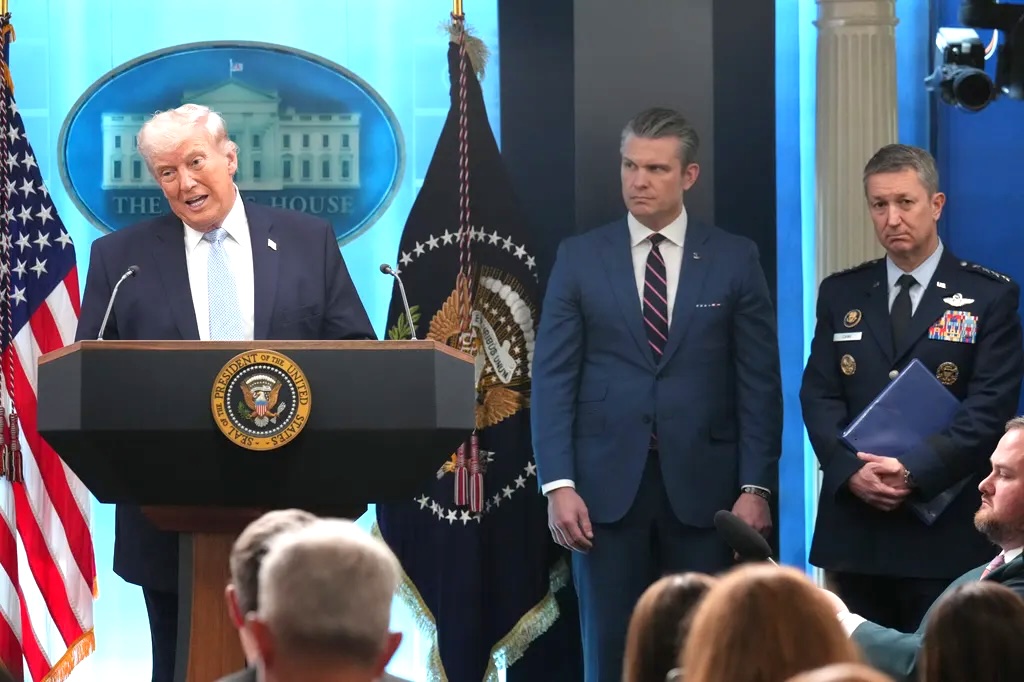
FILE – President Donald Trump speaks with reporters during a news conference in the James Brady Press Briefing Room at the White House, Monday, April 6, 2026, in Washington, as Defense Secretary Pete Hegseth and Chairman of the Joint Chiefs of Staff Gen. Dan Caine listen. (AP Photo/Mark Schiefelbein, File)
If the objective is not regime change, why should the U.S. or Israel fight another war against Iran? That is the question the Trump administration has yet to answer.
Military strikes, ceasefires, negotiations, renewed attacks, and another pause have become a recurring cycle that plays directly into the Islamic Revolutionary Guard Corps’ strategy. Every lull allows Tehran to rearm, rebuild, replenish its missile stockpiles, and adapt. Washington appears trapped in a cycle of escalation and de-escalation without defining what victory actually looks like.
That is America’s first and most consequential strategic mistake.
The administration has never adequately explained to the American people why confronting Iran advances U.S. national security, what victory means, or why the costs are justified. Americans deserve more than reports of successful military operations; they deserve a strategy. Without it, they understandably question higher energy prices, greater regional instability, and the risk of another prolonged Middle East conflict.
Washington’s second mistake has been assuming that transactional bargaining alone can succeed against an ideologically driven revolutionary Islamist regime.
Iran’s leadership is not simply pursuing traditional geopolitical interests. The Islamic Republic believes it is carrying out a divinely inspired revolutionary mission. The Islamic Revolutionary Guard Corps seeks to drive the U.S. from the Middle East, eliminate Israel and dominate its Sunni Arab neighbors. Negotiating with such a regime requires understanding revolutionary ideology, religious conviction, and the strategic patience that has defined Tehran’s behavior for nearly five decades.
Despite these realities, the United States has achieved remarkable military success. Iran’s economy is reeling and nearing collapse. Its military has been decimated. Yet continuing drone and missile attacks against U.S. forces and commercial shipping create the false impression that Tehran remains strategically ascendant.
That is the nature of asymmetric warfare. A weakened adversary can still inflict pain without possessing strategic momentum. Tactical victories alone, however, cannot produce lasting success without a political strategy.
Iran understands America’s greatest vulnerabilities: casualties and higher energy prices. It will continue targeting U.S. bases, Gulf partners, and international shipping because it believes American political resolve will collapse long before the Islamic Republic’s. To an American public that has never been fully briefed on the strategic importance of the Strait of Hormuz or the long-term threat posed by Iran, the only visible measure of success or failure becomes the number of American casualties.
For decades, many Middle East analysts have argued that as long as the current regime survives, military campaigns against Iran can only postpone the next war. Americans naturally compare another confrontation with Iran to Iraq and Afghanistan because the administration has not convincingly explained why this conflict will end differently.
Former National Security Adviser HR McMaster has argued that the U.S. should support Iran’s opposition by arming opposition groups. In addition, communications, logistics, coordination, and military assistance are essential. Such a strategy should unite Iran’s diverse anti-regime movements, including the overwhelming majority of Persians who want to throw off the shackles of 47 years of repression.
Instead, President Trump was misled by Turkish President Recep Tayyip Erdoğan, who lobbied against supporting a Kurdish-led uprising that could have become the catalyst for a broader national resistance. Erdoğan was pursuing Turkey First, not an America First agenda. His government had every reason to prevent the emergence of a democratic, pro-Western Iran that would fundamentally reshape the regional balance of power.
History offers a precedent. During the Cold War, American support for the Afghan resistance imposed unsustainable costs on the Soviet Union and forced Moscow’s withdrawal. Iran presents a different opportunity. Unlike Afghanistan in the 1980s, 80 to 90 percent of Iranians seeking regime change are among the most pro-American Muslim populations in the Middle East. Millions have repeatedly taken to the streets demanding freedom despite the possibility of imprisonment, torture and death. They represent America’s greatest untapped strategic asset.
Regime change would neither be quick nor easy. It would require patience, sustained economic pressure, coordinated support for the opposition, and denying Tehran its greatest source of leverage, the Strait of Hormuz.
For decades, the U.S. military has planned for reopening the waterway if Iran attempted to close it. Maintaining freedom of navigation would require a coalition of American, European and Asian partners while alternative energy routes continue to develop. Combined with economic isolation and growing internal pressure, such a strategy offers the best chance to weaken the regime politically, economically and militarily.
None of this would be easy. None of it would be quick.
But policymakers owe the American people an answer. If regime change is not the objective, what is the strategy that permanently prevents Iran from rebuilding its military, reviving its nuclear ambitions, and threatening the United States, Israel and America’s Arab partners?If the answer is simply another cycle of airstrikes followed by ceasefires and negotiations, Washington is not solving the problem — it is merely managing it unsuccessfully.
America has repeatedly demonstrated they can win battles against the Islamic Republic. Until policymakers define a strategic vision equal to the sacrifices they ask Americans to bear, tactical victories will continue to postpone, not prevent, the inevitable next war.
This article appeared in The Hill on August 3, 2026.
Eric R. Mandel is the director of the Middle East Political Information Network and senior security editor for the Jerusalem Post’s Jerusalem Report.