
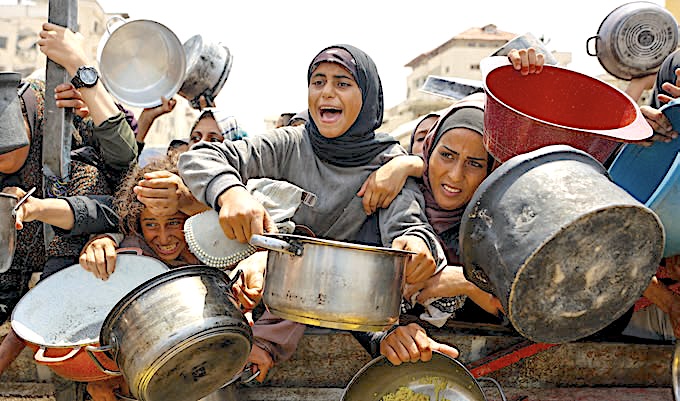
Palestinians gather to receive cooked meals from a food distribution center in Gaza City in August. OMAR AL-QATTAA/AFP VIA GETTY IMAGES
How does a nation survive in a regional sea of hatred, fighting jihadists who kidnap, rape, plunder, and remain unrepentant, while confronting Salafist Hamas terrorists who use their own civilians as human shields to manipulate a world predisposed to disparage the Jewish state?
Rule number one: Don’t fall into the jihadist traps.
Prime Minister Benjamin Netanyahu’s plan to gradually expand Israel’s control over Gaza if all the hostages are not released risks being precisely such a trap. Hamas thrives on drawing Israel into protracted military and political quagmires. According to a Jerusalem Post editorial, IDF Chief of Staff Lt.-Gen. Eyal Zamir warned, “Everything will be complex; I suggest that you remove the return of the hostages from the military objectives.”
Eighteen months ago, I advocated separating Gaza’s civilian population from Hamas’s military apparatus – a concept with merit. But the Biden administration had already committed itself to “deescalation at any cost,” slow-walking arms deliveries and effectively prolonging the war. Today, even if Netanyahu’s plan is tactically sound itself, the timing is problematic. The international humanitarian narrative – particularly around food distribution – is being weaponized to undermine Israel while advancing Hamas’s strategic goals.
Crossing the Rubicon
The unacknowledged Rubicon that Israel may be crossing is the shift from being a non-occupying power in Gaza – with Hamas still entrenched in Gaza City and the refugee camps – to becoming a full-fledged occupier. That shift would bring legal responsibilities and obligations under the Geneva Conventions that the international community would eagerly use to further delegitimize the Jewish state.
Full control of Gaza means that Israel would be legally responsible for food, healthcare, policing, and education for a population both complicit in terrorism and indoctrinated with antisemitism for generations. The costs – in resources, manpower, and international standing – would be staggering.
The American factor
While global opinion will always be sharply critical of Israel, the countries whose perceptions matter most are the United States and, to a lesser extent, Germany. The next phase of the war is politically treacherous, potentially appearing indecisive to both friends and foes. As The Wall Street Journal noted:
“If Israel’s goal is to vanquish Hamas, the new plan isn’t enough. It certainly won’t pacify critics abroad, and it may not be enough to spring more hostages. All of which means that Israel could, in a few months, be faced with the same hard choice it now tries to dodge.”
If Special Envoy Steve Witkoff and the Qatari supporters of Hamas cannot pressure Hamas into another ceasefire to end the war with Hamas defanged and exiled, Americans sympathy and understanding of Israel’s security and legal obligations will be blurred, especially if Israel is considered by the Trump administration to have become an occupying government of the whole Gaza Strip.
The humanitarian storm – whether exaggerated or not – will eventually pass. But the burden of occupation will remain an albatross on the Israeli economy, diverting funds and focus from other urgent fronts: Iran’s nuclear ambitions, Hezbollah’s threat from Lebanon, Iranian entrenchment in Syria, and instability in Judea and Samaria. Domestically, the strain will fuel internal divisions, even as at least 20 hostages remain in captivity under what can only be described as Auschwitz-like conditions.
A Strategic Inflection Point
In August, shortly after Netanyahu unveiled his Gaza plan, I spoke at a high-level conference on Israeli security and US–Israel relations. The gathering brought together US senators, foreign policy advisers, public relations experts, social media strategists, and Middle East analysts. My focus was the regional geopolitical landscape.
I told the audience that 2025 may prove as consequential for the Middle East as 1979 – the year of the Iranian Revolution – or 2011, the onset of the Arab Winter. Those events unleashed destabilizing forces still shaping the region’s politics and security architecture today.
At the time, I had just published an article in The Hill arguing against an Israeli occupation or annexation of Gaza. Days later, Netanyahu responded to Hamas’s rejection of an American-mediated partial ceasefire by ordering the IDF to begin reoccupying the entire Gaza Strip – aiming to dismantle Hamas and penetrate Gaza City’s still-functioning command network and underground infrastructure.
Military reality check
According to IDF Chief of Staff Eyal Zamir, conquering Gaza could take five months, with follow-on operations lasting two years. Zamir – handpicked by Netanyahu – has reportedly been critical of the plan, prompting talk of replacing him. Netanyahu’s own national security adviser, Tzachi Hanegbi, is also said to be skeptical.
Netanyahu ally Brig. Gen. (res.) Amir Avivi has described the plan as a “war of attrition” around the refugee camps. But Israel could wage a similar war of attrition while holding a two-kilometer buffer zone and controlling three critical corridors, protecting soldiers and minimizing the risk of inadvertently killing hostages. Either approach demands patience – something measured in years by Middle Eastern standards, not the “instant results” mindset of the West.
Domestic and diplomatic strains
The human toll on Israeli society will be severe: more soldiers killed or permanently disabled, more grieving families, and more strain on the social fabric. Politically, Netanyahu risks of underestimating the fracturing effect on Israel’s relationship with the American public and Congress, including long-standing allies. Counting on President.
Donald Trump to remain steadfast is risky – especially as months pass and Western media continue broadcasting images of Palestinian suffering, real or fabricated, ahead of the 2026 US midterm elections.
The Israel Democracy Institute has outlined the implications of occupying Gaza: diplomatic isolation, national security complications, economic burdens, and the moral consequences of ruling over more than two million Palestinians. National Unity leader Benny Gantz recently criticized Europe’s moves toward unilateral recognition of a Palestinian state, weapons restrictions, and public condemnations of Israel.
“These actions are harming the prospects of securing a hostage deal. They inadvertently reward terror, harden Hamas’s position, and prolong the war,” Gantz warned. “Instead of pressuring Israel, the West should focus on ending Hamas leadership’s impunity abroad.”
His words resonate in Israel but fall mainly on deaf ears in Europe – and increasingly in parts of the United States.
Avoiding the occupation trap
If Israel is truly committed to reoccupying Gaza, it must coordinate with Washington at an unprecedented level to mitigate the cascade of adverse outcomes likely to emerge. That means setting clear, shared objectives with the US administration and ensuring that tactical moves do not undermine strategic alliances.
Ultimately, undermining Hamas’s jihadist infrastructure requires more than battlefield victories. Netanyahu must convince the US president – whoever holds the office – that the surest way to end the war and free the hostages is to pressure Qatar, Hamas’s chief benefactor, to force the group’s disarmament and exile. Washington has the leverage to make that happen, should it choose to use it.
That would be a diplomatic victory of historic proportions – one worthy of a Nobel Peace Prize.■
Eric Mandel is the director of MEPIN, the Middle East Political Information Network, and senior security editor of The Jerusalem Report. He briefs members of Congress and their foreign policy aides, as well as the State Department.