
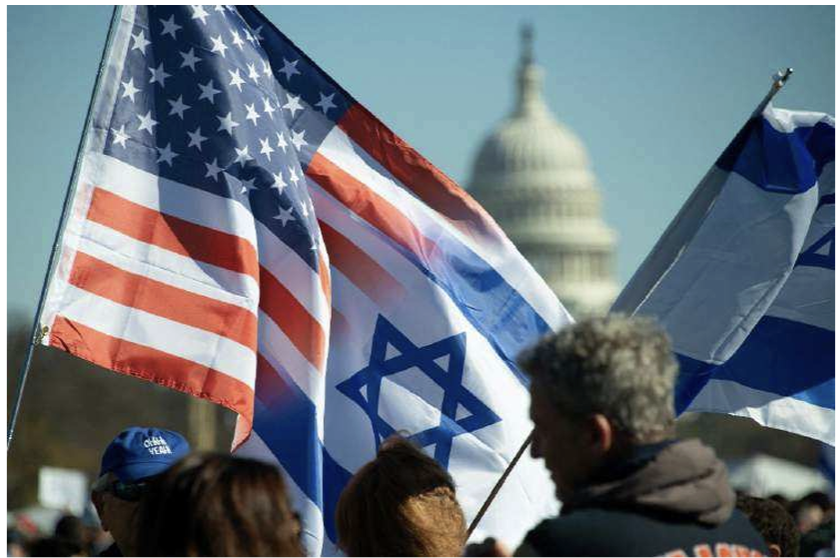
Participants at the March for Israel in Washington DC, November 2023 (photo: Rena Schild)
Beyond Military Aid: A Concrete MOU Proposal
by Dr. Raphael BenLevi
A Framework for U.S.-Israel PostAid Strategic-Industrial Cooperation
Beyond Military Aid: A Concrete MOU Proposal Dr. Raphael BenLevi | June
2026 Participants at the March for Israel in Washington DC, November
2023 (photo: Rena Schild) Main Points

• Israel’s strategic role has evolved from aid recipient to full U.S.
partner.

• The current aid-based framework no longer reflects this reality.

• A post-aid model should strengthen, not weaken, the U.S.-Israel
alliance.

• Israel should gradually assume full responsibility for funding its own
defense.

• The United States and Israel should deepen technological, industrial,
and operational cooperation.

• The new framework should include supply guarantees, joint production,
futuredefense technologies, and broader regional integration.

• The paper concludes with concrete proposed language for a new MOU and
accompanying Letter of Intent.

Introduction Israel’s newfound status as strategic partner of the United
States in the Middle East, as exemplified by the unprecedented
cooperation during operations Epic Fury/Rising Lion, stands in stark
contrast with the current framework for defense industrial cooperation,
centered around military aid grants. An emerging consensus in both
Washington and Jerusalem views the aid as anachronistic and seeks
changes that will bring it into alignment with Israel’s role as a full
strategic partner. An independent Israel that can decisively defeat its
enemies and fund its own military will be a valuable asset and model
ally.

As the two countries are in the process of discussing the parameters of
a new MOU, they should approach it as a process of evolution. This paper
identifies a) aspects of the current model that continue to serve the
relationship well and should be maintained; b) aspects which are no
longer in their mutual interests and should be updated; and c) new
elements that should be incorporated to realize their full potential as
partners.

The transition away from American military aid should not be understood
as a weakening of the U.S.-Israel relationship but as the natural
evolution of a partnership that has matured over decades. Israel’s
growing economic and military strength allows it to assume greater
responsibility for its own defense while contributing more meaningfully
to shared strategic goals. The guiding principle should be Israeli
independence in funding and capability alongside greater integration in
strategy. By replacing an aid-based structure with deeper technological,
industrial, and strategic cooperation, Washington and Jerusalem can
build a relationship better suited to the geopolitical realities of the
twenty-first century.

This paper outlines proposals for how to implement a partnership model,
divided into the following categories:

• Funding acquisitions and mutual supply guarantees

• Utilizing Israeli capabilities for future technologies

• Integrating Israel and U.S. production, maintenance and warfighting

• Integrating Israel into broader U.S. global agenda

• Regional considerations It proposes numerous avenues to concretize a
partnership model through each of the above categories. Many of these
proposals are relevant to include explicitly in the new MOU, others
could be included in a Letter of Intent (LOI) attached to the MOU, and
others would be best pursued independently of the MOU. It concludes with
a proposal of the text for a new MOU and LOI.

The Prospect of Strategic Partnership The unprecedented cooperation
between Israel and the United States in their March 2026 war with Iran
marked the culmination of a long shift in the nature of the
relationship - from patronage to partnership. Elements of partnership
always existed, but the relationship has now entered a qualitatively
different phase. Never before have the two countries undertaken joint
military action against a mutual enemy. Rather than relying on the U.S.
to do the heavy lifting with the ally playing supporting roles, Israel
operated as a full partner, dividing targets and operational
responsibilities with U.S.

forces.

Israel’s newfound status as strategic partner in the Middle East,
however, stands in stark contrast with the current framework for defense
industrial cooperation. Under what can be called a patronage model, the
U.S. currently provides Israel with $3.3 billion annually in Foreign
Military Financing to purchase American-made equipment, and an
additional $0.5 billion for joint missile-defense projects already under
a partnership model. Yet an emerging consensus in both Washington and
Jerusalem views the aid as anachronistic and seeks changes that will
bring it into alignment with Israel’s role as a full strategic partner.
Prime Minister Netanyahu has stated: “We’ve come of age and we’ve
developed incredible capacities… and our economy will reach about $1
trillion in the coming decade. So, I want to taper off the military aid
in the next ten years.” In Washington today, there is a strong desire to
see partners and allies across the globe move toward funding their own
defense needs and away from subsidies and grants from the U.S. To better
focus on its strategic priorities in the coming decade, the U.S. needs
to direct its resources more carefully and therefore seeks capable
allies that carry their own weight.

In Jerusalem as well, there has been a growing sense over the past two
years of war that it is unhealthy to be so dependent on American
resupply and largesse. The Biden administration’s withholding of
munitions during critical periods of the first year of the war has
driven home for many Israelis the need to re-establish its independence
in this realm. Israel has also noticed that criticism of the aid has
become widespread in both parties. Finally, previous decisions to grant
aid were made, in many cases, to offset security risks that Israel
assumed under the rubric of ‘land for peace’. However, given the
prevailing mindset post October 7th, Israel is not going to be taking on
new security risks by forfeiting territory any time soon.

The transition to a partnership model will offer new opportunities and
avenues to deepen cooperation which is mutually beneficial to each
country’s broader security strategies. To better focus on its interests
in the Western Hemisphere while also winning its great power competition
with China, the U.S. seeks strong, reliable partners in key regions
around the globe. Israel is emerging as the paradigm of such an ally,
who can contribute to U.S. strategic goals in the Middle East, as well
as in security realms relevant to other regions.

The United States and Israel face a converging set of threats from both
state and nonstate actors. Iran and its proxy network represent the
central threat to Israel and a toptier destabilizing force for U.S.
regional interests. U.S. rivals, China and Russia, coordinate closely
with Iran and rely on it as the leader of anti-U.S. actors in the Middle
East. Israel and the U.S. also share operational threats in the form of
cyber, drones, and missiles alongside the convergence of terrorist and
international crime organizations.

In this context, an independent Israel that can decisively defeat its
enemies and fund its own military will be a valuable asset and model
ally. Israel can anchor America’s Middle East strategy, serving as the
bridgehead of the pro-American camp alongside the Gulf States,
countering anti-Western forces, and underwriting the security needed for
a post-Islamic Republic era of prosperity. If the regime survives the
current war, Israel would lead efforts to prevent its resurgence,
freeing U.S. attention and resources for priorities outside the region.

The Benefits and Drawbacks of Aid On the strategic level, a popular
argument put forth in favor of the aid model is that it is a concrete
sign of U.S. support for Israel which strengthens deterrence against its
enemies, as well as a sign of continued U.S. commitment and influence in
the region.

Though there may be some truth to this, the current structure also works
to undermine deterrence, as it projects an image of Israel as a
dependent client, incapable of standing on its own two feet. Deterrence
is ultimately judged in its failure, and clearly the symbolic value of
aid was not enough to deter Iran from facilitating the multi-front
existential war against Israel, launched in October 2023. Rather, the
perception of U.S.

commitment to Israel and to the region stands or falls on its concrete
actions in the face of actual threats. If the U.S. has continued
security interests in the region, then its actions will demonstrate
this; if not, aid to Israel will not convince anyone.

On the economic level, it is frequently argued that the aid model is
mutually beneficial, as it provides Israel with much-needed resources,
for sums that are relatively minor when considering the $7 trillion
dollar U.S. budget. Further, it is said that because the aid is all
spent on purchases from American manufacturers, it serves to create
jobs. It also encourages sales of U.S. weaponry to third parties as
Israel demonstrates the superiority of U.S. weapons platforms on the
battlefield.

There is much truth here too, but it is far from clear that the value of
these benefits is greater than an alternative partnership model. The
$3.3 billion a year of FMF is indeed more economically significant for
Israel than for the U.S. However, what is not fully appreciated is just
how much Israel’s economy has grown since the aid model was instituted
in the 1970s. Since that time, the value of aid has been more or less
consistent around $3 billion a year. Therefore, accounting for
inflation, its real value has diminished over time. In contrast,
Israel’s GDP has grown by a factor of ten in real terms. Together, this
means that the economic significance of the aid for Israel has changed
by orders of magnitude. While in the 1970s, on average the aid
constituted 19% of Israel’s GDP and 23% of its state budget, today it
amounts to only 0.9% of GDP and around 3% of the state budget.

Source: Dataset compiled by the author. Sources include: the World Bank,
the Knesset website, the United States Department of State website, and
others. The aid figures include grants (from 1974 onward) and loans
(until 1984), military aid (for all years), economic aid (until 2007),
as well as dedicated missile defense funding (from 1990 onward). For
2020-24 the numbers include the additional emergency aid given during
the October 7th war. Discounting the additional emergency aid, the
percentage of the budget drops to 2.8%.

Israel does indeed bear tremendous security costs, consistently
investing between 4-6% of GDP - higher than any other democratic state
with a modern economy. Trump has demanded that NATO countries invest 5%
of their GDP in defense, while they remain far from reaching that goal.
The close-to-3% of Israel’s state budget provided by the aid is not a
trivial amount to forgo. Finding alternatives will require budgeting
adjustments and long-term reforms. Nevertheless, with a $610 billion and
growing economy, it is entirely feasible for Israel to undertake a
gradual transition away from aid and toward fully funding its own
acquisitions. Israel has, in fact, already taken into account the
possible drawdown of aid in its new long-term IDF build-up plan,
approved by the Ministry of Finance.

The current framework for defense-industrial-technological cooperation
has also had the side effect of degrading Israel’s indigenous military
industry in general and most acutely its capabilities for independent
munitions production. When there are FMF dollars to spend, it simply
becomes more convenient to buy off the shelf munitions from the U.S.
than to make the long-term commitment of orders that Israeli
manufacturers need to justify maintaining production lines. And so,
munitions production lines were simply allowed to close while Israel
continued purchasing large quantities with FMF dollars from U.S.
manufacturers. This phenomenon is especially acute since the phaseAid as
a % of Israel’s GDP Aid as a % of Israel’s state budget 1974-79 19.0%
23.3% 1980-89 8.3% 11.2% 1990-99 4.1% 7.5% 2000-09 1.8% 4.8% 2010-19
1.2% 3.6% 2020-24 0.9% 3.3% out of “off shore procurement”, that is, the
portion of FMF that could be converted to shekels for purchases from
Israel’s defense industries.

Looking at the U.S. side of the economic balance, it is true that
without the aid, Israel may shop around for some of the capabilities
that it currently purchases with FMF dollars. Israel certainly intends
to manufacture more of its munitions in-house. But Israel is not in a
position to indigenously develop and manufacture its own jet fighter
platforms, on which the bulk of the aid is spent. This means that even
after the aid, Israel will continue to acquire these platforms from the
U.S. in roughly the amount that it does today. The difference is that it
will be Israeli money entering the American economy and creating
American jobs instead of American tax dollars spent by the U.S.

government. Israel will continue to use and enhance U.S. weaponry,
raising its value internationally just as it does today.

Finally, it is said on the political level that the aid framework
facilitates the deep defense-industrial cooperation between the
countries to their mutual benefit. However, as much as it has
facilitated cooperation and connections between the countries, today it
is undermining the very alliance it is meant to uphold. What the
American public appreciates about Israel is its image as a courageous,
initiative-taking nation, that does the impossible and succeeds against
all odds. Israel remains that nation. But it is increasingly difficult
to argue that the start-up nation, at the forefront of global tech,
whose economy has continued to grow even during its longest war, still
requires handouts from the American taxpayer. Israel cannot be both the
start-up nation while at the same time receiving vast sums of aid in a
model similar to third-world economies.

Beyond undermining Israel’s image, at a time of unprecedented
partisanship in America, the need for Congress to regularly pass the
bills necessary to keep the aid flowing gets Israel unnecessarily
tangled up in American domestic politics. During 2024, the aid
appropriations for Israel were held up by the disagreements over aid to
Ukraine and U.S. border security. Furthermore, the very fact that
Congress grants these funds makes Israel into an acute political issue,
as representatives feel they are directly responsible for everything
Israel does with its funds. For many years, Israel was concerned that
bipartisan support was important to keep the aid flowing; today the
existence of aid contributes to the undermining of bipartisan support.
On the other hand, the positive effects of deep cooperation can be
attained by maintained and expanded under a partnership model, of the
type proposed here.

The current model was last codified in the 2016 Memorandum of
Understanding (MOU), which runs through 2028. As the two countries
discuss the parameters of a new MOU, they should approach it as a
process of evolution. This requires carefully delineating between
aspects of the current model that continue to serve the relationship
well and should be maintained, aspects which are no longer in their
mutual interests and should be updated, and new elements that should be
incorporated to realize their full potential as partners.

The transition away from American military aid should not be understood
as a weakening of the U.S.-Israel relationship but as the natural
evolution of a partnership that has matured over decades. Israel’s
growing economic and military strength allows it to assume greater
responsibility for its own defense while contributing more meaningfully
to shared strategic goals. The guiding principle should be Israeli
independence in funding and capability alongside greater integration in
strategy. By replacing a patronage-based aid structure with deeper
technological, industrial, and strategic cooperation, Washington and
Jerusalem can build a relationship better suited to the geopolitical
realities of the twenty-first century.

The following section of this paper outlines proposals for how to
implement a partnership model. It divides these proposals into five
categories:

• Funding acquisitions and mutual supply guarantees

• Utilizing Israeli capabilities for future technologies

• Integrating Israel and U.S. production, maintenance and warfighting

• Integrating Israel into broader U.S. global agenda

• Regional considerations Funding Acquisitions and Mutual Supply
Guarantees 1. Gradually transition from FMF with matching of Israeli
funded purchases The countries could transition away from aid and toward
a partnership model while preserving those elements of the current
framework that are mutually beneficial. The most significant challenge
to this change is that in the coming years, Israel will need substantial
investment to rebuild, rearm, and even expand the IDF after two and a
half years of intense war. Moreover, Israel and U.S. companies have
already contracted for the sale of new fighter jets in the amount of
approximately $20 billion. Therefore, to balance Israel’s desire to move
beyond aid with its urgent need to rebuild the IDF, a new MOU for
2028-2038 should outline a gradual ten-year phase-out of $3.3 billion a
year in FMF grants.

At the same time Israel should commit to matching the overall amount of
aid given during the phase out period with Israeli funded purchases
which would be phased in over the decade.

2.  Maintain and expand BMD collaboration Unlike the FMF grant
    framework, the additional $0.5 billion a year invested in ballistic
    missile defense (BMD) already operates under a collaborative
    framework. For the $300 million research, development, testing, and
    evaluation (RDT&E) component, U.S.

funds are matched by Israel annually and the intellectual property
rights of this effort are shared. For the $200 million
procurement/co-production component, 50% or more must be spent in the
United States. This cooperation could be maintained and expanded to meet
both countries’ needs.

In the coming years, the countries must focus on expanding production
capacity for interceptors, given how quickly they can be used up in a
high-intensity war. This means accelerating co-production of
interceptors for operational systems as well as pushing forward High
Energy Laser systems, which are vastly cheaper.

US FMF grants Israeli funds $US $US 2028 3,300,000 2029 2,970,000
330,000 2030 2,640,000 660,000 2031 2,310,000 990,000 2032 1,980,000
1,320,000 2033 1,650,000 1,650,000 2034 1,320,000 1,980,000 2035 990,000
2,310,000 2036 660,000 2,640,000 2037 330,000 2,970,000 2038 0 3,300,000
Total FMF for 2029-2037 14,850,000 Total Israeli funds for 2029-2037
14,850,000 3. Two-way fast-track procurement for defense articles The
current model provides for fast-track mechanisms to reduce bureaucratic
delays and ensure Israel’s access to U.S. defense technologies. This
should be maintained even once Israel is financing its purchases
independently. It should be expanded to include an Israeli guarantee to
prioritize U.S. access for articles it sells to the U.S. Military.

Israeli systems purchased by the U.S. include: Trophy Active Protection
System for protecting tanks against anti-tank-guided-missiles and rocket
propelled grenades and the Iron Fist Light Configuration active
protection system for armored personnel carriers, both used by the U.S.
Army; The Common Laser Range Finder used by the U.S. Marine Corps to
concealed positions with imaging, range-finding, and navigation through
combat areas; Joint Helmet Mounted Cueing System; LITENING Targeting
Pod; UAV (Unmanned Aerial Vehicles); Python-4 Air-to-Air Missile and
more.

4.  Mutual guarantee not to block delivery for political reasons.

Unfortunately, we have seen attempts to block delivery of equipment for
purely political reasons and this could repeat itself even for equipment
purchased independently without FMF. The countries should explore
possibilities to protect against this including legislation in the
Senate. The commitment should be mutual, in which Israel guarantees to
the same for any equipment it supplies to the US.

Utilizing Israeli Capabilities for Future Technologies 5. Establish
investment funds for U.S. investment in Israeli defense tech Israel is a
leading innovator in high-tech, particularly defense technologies. To
keep both countries at the forefront of the tech arms race, they could
establish investment funds allowing the U.S. government or private
investors to fund R&D for Israeli companies with a clear financial
return. Returns could also be strategic, such as guaranteeing U.S.
purchases at cost price or other mutually beneficial arrangements.

These funds could cover cyber, AI, quantum technology, drones and
counter-drone systems, remotely piloted fighter aircraft,
directed-energy (laser) systems, and space and satellite technology.
This could be similar to the BIRD framework that currently exists for
non-defense technologies.

6.  Integrate Israel into Golden Dome project One new potential avenue
    of expanded cooperation is the Golden Dome project. Israeli
    ingenuity and practical experience in conducting mass interceptions
    against ballistic missiles, drones, and cruise missiles, could be of
    vital importance for the administration’s new project. Israel’s role
    could be as technology supplier, especially for interceptor concepts
    and lasers; as a subcontractor or partner to U.S. primary
    contractors; and in an advisory role, with Israeli combat and
    engineering experience feeding into U.S. design decisions.
    Specifically, Israeli industries could contribute in the radar and
    threat detection realm, and as well in interception. The Arrow 3
    system has proven itself highly combat effective against both
    long-range ballistic missiles and could be adapted for other
    contexts.

The land-based capabilities of the currently fielded Arrow-3 could be
employed roughly as-is and could also be adapted to hit threats orbiting
Earth in space, or intercept during the boost phase. Israel has another
advantage as it could potentially provide systems for the dome in a mere
two to three years. Israel could also contribute in laser interception.

7.  Israel’s role in next-generation fighter F47 Israel could also play
    a key role in developing the next-generation F-47 and its advanced
    subsystems. For example: broadband satellite communications,
    multi-layered encryption systems integrating hardware and software,
    electronic warfare and soft and active defense systems, adaptive
    multi-purpose munitions, AR displays (helmets and cockpits with
    augmented reality), and synthetic aperture radars (SAR). In nearly
    all of these fields, Israel is at the forefront of technology
    globally.

Integrating Israel and U.S. Production, Maintenance and Warfighting:

8.  Make Israel regional hub for depot-level maintenance for platforms
    including the F35 Israel has unique technical capabilities for the
    high-level maintenance required to sustain a combat-ready fleet.
    Designating it as a depot for the U.S. military itself and other
    U.S. partners would strengthen the U.S. alliance network in the
    region and provide an efficient, local alternative for maintaining
    these platforms. The U.S. military currently flies its planes
    stationed in the Middle East vast distances at great cost to perform
    maintenance. Doing even part of this in Israel would save
    significant costs.

Israel could also provide these services to U.S. partners in the Middle
East region, potentially even Saudi Arabia if it normalizes relations.
Greece, who is expected to receive the F35 in 2028, or other European
operators could also do their depot-level maintenance in Israel. The
U.S. could also consider transferring the manufacturing of F35
components from other locations to Israel.

9.  Israel’s munitions production capacity as a component in U.S. and
    allies supply chain Israel is already in the process of rebuilding
    its manufacturing lines for a variety of munitions. This is
    necessary both to ensure its independence in warfighting and given
    that the U.S. is experiencing a lack in its supply and production
    capacity, especially in the event of a direct conflict. The
    challenge in Israel is how to maintain the economic feasibility of
    these manufacturing lines over time, once stockpiles have been
    established. Israel and the U.S. could come to an agreement for
    Israel to be a supplier to the U.S. military, as well as for U.S.
    allies who are also in need of munitions. Part of this would entail
    cooperation to secure the critical raw materials necessary for
    munitions. Conditions could include that Israel grant supplying the
    U.S. priority during a U.S. war; Israeli priority during an Israeli
    war, and sell to U.S. and allies during peacetime.

10. Flight-data sharing and enhancements to American platforms Israel is
    the leading combat user of the F35 and has much experience with
    additional platforms such as the F15. Israel currently shares with
    the U.S. invaluable flight data from its combat experience that
    helps the latter use its jets more efficiently and to develop newer
    versions and upgrades to the platforms. This information sharing
    should be formalized in the MOU and also accounted for in future
    contracts for Israeli purchases of American platforms. Likewise,
    Israeli enhancements to the F35 are already being shared with
    manufacturers to great benefit. Israel’s extended range
    modifications reduce exposure of re-fueling tankers to attack and
    have direct benefit to U.S. potential warfighting theatres. Also,
    electronic warfare modifications help Israel against air-defense
    systems in Iran. Israel’s sharing of modifications should also be
    formalized.

11. Establish dialogue on new warfighting doctrines in the era of drones
    and missiles Over the course of Israel’s Iron Swords War and
    particularly in the front with Iran, Israel has moved one step ahead
    in future warfighting. Israel implemented a doctrine of decapitation
    to paralyze enemy command and control structures that could be
    highly relevant to possible U.S. conflicts in other regions. In
    addition, Israel has lessons in mass drone warfare, both offensive
    and defensive, as well in maintaining the F35 and operating it with
    unprecedented efficiency. Senior US officials have said that lessons
    learned by these high-tempo Israeli F-35 operations will be
    especially important in preparing for a fight in the Pacific.

There are also tactical ground fighting lessons to be discussed on urban
warfare, counter-tunnel methods. A formal forum for dialogue on Israel’s
doctrinal lessons from the past two years could be established. As well,
the joint warfighting during Operation Epic Fury/Roaring Lion
demonstrated the vast potential for cooperation and mutual enhancement.
A formal forum could be established to share these doctrinal lessons
with the U.S. and its allies.

12. US basing in Israel Israel should consider offering the U.S. a
    long-term military footprint in its borders.

The Roaring Lion/Epic Fury operation have clarified the advantages of
such an arrangement for both sides. Major considerations should be to
utilize a location that is operationally valuable, but will minimize any
potential constraints on Israel’s future freedom of action. Israel can
offer to host the American forces, but funding for any construction
necessary should be primarily American.

13. US-run nuclear power plants in Israel Israel currently faces
    obstacles that prevent its utilization of nuclear energy as it is
    not a signatory to the NPT. However, coming to a unique agreement
    with the U.S. for American nuclear power plants in Israel could be a
    mutually beneficial solution that will help Israel meet its energy
    needs for growing AI data centers.

14. Release or lend-lease of platforms/technologies Historically, the
    U.S. has not been interested in selling certain platforms that
    Israel may lack. The countries can consider a lend-lease agreement
    that would allow Israeli usage with fully exporting these platforms.
    A strategic bomber is currently a leading platform of this sort
    alongside bunker buster bombs.

Integrating Israel into Broader U.S. Global Agenda 15. Expand
intelligence sharing dialogue on external actors in Middle East The U.S.
and Israel already share intelligence closely, and existing arrangements
should be maintained and acknowledged as part of Israel’s contribution
to U.S. security.

Cooperation could be expanded to have Israel provide intelligence
specifically on the presence and activities of external actors who are
hostile to the U.S., across the Middle East. Utilizing and growing
Israeli intelligence capabilities in this way could be of great mutual
value to American interests globally.

16. Israeli release technologies to U.S. allies/partners in East-Asia:
    export Arrow to India In order to strengthen U.S. allies’ and
    partners’ abilities to face their own security challenges, the U.S.
    and Israel should identify which of their needs could be met by the
    export of Israeli defense technologies and systems. Israeli
    knowledge, experience, and technologies could support U.S. allies in
    East Asia, including the Philippines, Vietnam, Taiwan, Japan, and
    South Korea (and potentially Indonesia if it decides to establish
    relations with Israel). This could include training programs and
    facilitating exports of Israeli capabilities and technologies to
    strengthen these partners.

Israel already exports various systems to many of these countries, and
what works on a bilateral basis can remain so. However, there are some
systems that require U.S.

approval. Specifically, India has expressed interest in the Arrow
missile defense system.

This would make strategic sense to bolster India’s defense and integrate
it into the broader U.S. alliance, as well as assist Israel in growing
its economy after aid.

Israeli dialogues on warfighting and lessons learned could also be
established with U.S.

allies/partners in East-Asia as part of this assistance to the U.S.
broader agenda.

17. Integrating cyber research and operations Israeli capabilities in
    cyber have great demand amongst mutual allies and partners of the
    US. However, in the past few years Israel significantly limited the
    countries it would sell these capabilities to, including at the
    request of the U.S. Now is the time for renewed consideration of
    expanding this list, in a cautious and coordinated way to assist
    worthy partners, who already meet criteria for the sale of sensitive
    weapons. The two countries should also explore possibilities for
    Israeli companies to provide cyberrelated services to American
    government users and for joint research and development projects.
    Doing so could limit proliferation of cyber capabilities to
    undesirable actors while keeping both countries at the forefront of
    technology.

18. Support further expansion of Israeli gas exports to Europe Israel
    already exports natural gas from its fields in the Eastern
    Mediterranean but more can be done to facilitate exploration and
    grow infrastructure that would allow greater exports to Europe and
    to position Israel as a regional hub for gas pipelines. There is
    likely more gas to be found and the U.S. could facilitate and
    encourage American companies to engage in further exploration and
    development. Among these steps could be considering investing in a
    Liquefied Natural Gas (LNG) plant in Israel or possibly in Cyprus to
    facilitate Israeli exports to Europe as an alternative supplier.

Regional Considerations 19. Regional integration of BMD architecture BMD
collaboration has been operationalized during Epic Fury/Roaring Lion.
This could be the basis for a more integrated missile defense among U.S.
allies in the Middle East.

20. Renew commitment to QME: conditions on sale of F35 to regional users
    Mechanisms to uphold Israel’s qualitative military edge should be
    maintained. Israel supports security cooperation with states that
    normalize relations with it but must guard against potential
    upheavals that frequently occur in the Middle East. This can be done
    by limiting the capabilities of the additional F35 users while also
    releasing new technologies to Israel.

Any sale of F35 should be conditioned on normalization with Israel as
well as guarantees that the technology would not be shared with China.
Beyond the stealth capabilities, the F-35’s advanced detection,
data-processing and networked systems are one of the pillars of Israel’s
air superiority in the region. Harm to Israel’s QME could be limited by
placing limitations on numbers of aircraft, timeline for delivery and
capabilities on any platforms sold to other countries in the region.
Reporting has mentioned seven years until first delivery, and limitation
to two squadrons only.

Limitations on capabilities could include at a minimum to exclude any of
the Israelideveloped upgrades which include classified avionics, locally
integrated mission systems and operational software Israel is uniquely
authorized to tailor. Beyond that, it would mean limiting the software
that manages electronic-warfare and targetrecognition.

Also, the type of weapons, meaning not selling the AIM-260 missile,
under development, which represents the most sensitive missile
technology associated with the F35 platform with a 120 mile-plus range
while releasing the missile to Israel.

Finally, the U.S. must have control of software updates, data systems
and maintenance diagnostics, spare parts, and depot-level support.

21. Review aid model to Egypt and Jordan to fully align with U.S.
    interests The emergence of FMF grants to Egypt and Jordan were,
    historically, tied to the establishment of aid to Israel. Therefore,
    as Israel moves to transition away from FMF, this should open a
    discussion on the continued logic of FMF aid to Egypt and Jordan as
    well. It is in Israel’s and the U.S. interest to maintain these
    regimes’ stability but they must also be expected to behave as
    allies. If Egypt and Jordan desire to maintain this model they
    should be required to more fully align with U.S. interests and make
    an independent case as to why this is beneficial. Part of this
    alignment should be that Egypt and Jordan must fully comply with the
    terms of their peace agreements with Israel, specifically regarding
    the growing Egyptian military presence in the Sinai Peninsula.

Given the aid they currently receive, and the assistance they receive
from Israel on civilian infrastructure (water, gas), both Egypt and
Jordan should commit to cease their hostile diplomatic activity toward
Israel in international forums.

22. Public rollout of new MOU should emphasize Israel’s growing strength
    and its desire to be a more independent U.S. ally The public rollout
    of a new MOU transitioning away from FMF grants should emphasize
    that it is the product of Israel’s growing strength and its desire
    to be a more independent U.S. ally. It should make clear that the
    change will not weaken strategic ties but rather strengthen the
    relationship. The mutual nature of the new agreement including
    Israeli commitments to buy American in the same amount of the
    phase-out FMF should be emphasized. This can be done with a joint
    press conference with both heads of state and possibly a speech by
    the Israeli PM to U.S. congress to clarify these messages.

23. Facilitate implementation of the India-Middle East–Europe Economic
    Corridor (IMEC) The IMEC provides a strategic economic counterweight
    to China’s Belt and Road Initiative while strengthening alignment
    among U.S. partners in the Middle East and Indo-Pacific. Integrating
    ports, rail, energy pipelines, and digital infrastructure, IMEC
    would deepen economic ties among pro-American states forged since
    the Abraham Accords and position Israel as a central logistical and
    commercial hub linking Asia, the Gulf, and Europe. In light of the
    recent vulnerability of the Straits of Hormuz, investing in
    alternative pathways for exporting energy from the Gulf have become
    more urgent.

Appendix 1: Proposed draft for new MOU1 *** MEMORANDUM OF UNDERSTANDING
(MOU) The United States and Israel affirm their mutual desire to deepen
their relationship in a way that strengthens their technological,
industrial, military and strategic cooperation.

This MOU, alongside the attached Letter of Intent (LOI), outlines the
pathway to transition away from Israeli reliance on U.S. financial
assistance and toward a model of strategic partnership which will
strengthen the national security of both countries.

I. Phase Out of FMF Grants and Israeli Matching Reflecting the mutual
desire to transition in a way that strengthens their security interests
and avoids dislocations in long-term planning, the countries resolve to
phase out all Foreign Military Financing grant assistance down to zero
over the course of the ten-year period beginning in Fiscal Year (FY)
2029 and ending in FY 2038. The drawdown will proceed linearly such that
in 2038 FMF grants with be zero. All of these FMF resources will be made
available exclusively to finance the purchase of U.S.

military goods and services in the United States.

In parallel, Israel will phase in its own funds with which it will
commit to purchasing U.S. military goods and services such that over the
course of the ten-year long MOU Israeli funds will match the total
amount of FMF funds for this period, according to the following
schedule:

1 The language from the previous MOU has been retained wherever
applicable.

US FMF grants Israeli funds $US $US 2028 3,300,000 2029 2,970,000
330,000 2030 2,640,000 660,000 2031 2,310,000 990,000 2032 1,980,000
1,320,000 2033 1,650,000 1,650,000 2034 1,320,000 1,980,000 2035 990,000
2,310,000 2036 660,000 2,640,000 2037 330,000 2,970,000 2038 0 3,300,000
Total FMF for 2029-2037 14,850,000 Total Israeli funds for 2029-2037
14,850,000 II. Missile and Rocket Defense Cooperative Programs In
contrast to FMF grants, the decades-long cooperation on missile, rocket,
and projectile defense is already structured as a partnership that
contributes directly to both countries’ national security. Therefore,
the United States supports mutual funding for cooperative programs to
develop, produce, and procure missile, rocket, and projectile defense
capabilities to help Israel meet its security needs and to help develop
and enhance U.S. missile defense capabilities. Such funding should, over
a ten-year period beginning in FY 2029 and ending in FY 2038, be
provided at the level of $500 million per year. Total funding over the
course of this understanding would equal $5 billion.

This level of funding is not associated with any particular quantity of
the Iron Dome, David’s Sling, Arrow 3 weapon systems, components or
interceptors. Also consistent with past practice, the United States and
Israel are to enter into separate bilateral agreements for such
cooperative programs.

The United States and Israel jointly understand that missile defense
funds are to be used primarily for the purposes of developing and
procuring articles and services necessary to missile, rocket, and
projectile defense systems for the defense of Israel. Both sides jointly
understand that any U.S. funds provided for these purposes should be
made available on the basis of best efforts at matching financial and
non-financial contributions by Israel for such systems, as negotiated in
the memoranda of agreement.

The United States and Israel note the importance of maximizing
co-production of parts and components of such defense systems in the
United States, at a level equal to or greater than 50 percent of
U.S.-appropriated funds for production, or as negotiated in the
production memoranda of agreement.

Based upon their comprehensive discussions, both sides jointly commit to
respect the missile defense funding levels specified in this MOU, and
Israel commits not to seek additional missile defense funding from the
United States for the duration of this understanding, except in
exceptional circumstances as may be jointly agreed by the U.S.
administration and Israel, such as in the event of a major armed
conflict involving Israel.

III. Purposes of U.S. Security Assistance, Promotion of Effective
     Cooperation, Transparency, and Accountability Both governments are
     committed to the most efficient expenditure of security funds.

Both sides understand that the ultimate intent of FMF assistance is to
help enable Israel to defend itself by itself and develop long-term
capacity, through the acquisition of advanced capabilities that are
available from the United States. Accordingly, with the commencement of
this MOU, both sides understand that FMF is not intended for the
purchase of fuel or other consumables.

The United States and Israel intend to continue their active dialogue on
security and security policy in existing bilateral committees. The two
sides expect, through ongoing bilateral consultations, to maximize
understanding and transparency regarding how U.S. funding is used for
defense purposes in Israel, as well as how U.S. financial contributions
to Israel’s security relate to Israel’s investment in its own security
via the expenditure of its national funds. To that end, Israel is to
provide:

a.  Detailed programmatic information related to the use of all U.S.
    funding.

b.  Program/acquisition plans for each weapons system procured using
    funds provided by the United States.

c.  An annual update on all cooperative defense programs, to include
    progress reports and spend plans, as well as the top-line figure of
    the Israel Missile Defense Organization (IMDO) budget.

Both sides acknowledge that the funding levels in this understanding
assume continuation of adequate funding levels for U.S. foreign
assistance and missile defense overall, and are subject to the
appropriation and availability of funds for these purposes.

IV. Mutual Commitment to Expedited Procurement and Delivery Of Defense
    Articles With the understanding that sales of military equipment
    between the United States and Israel serve both countries’ core
    national security interests, they commit to establishing and/or
    maintaining fast-track mechanisms to reduce bureaucratic delays
    whether purchased with FMF or Foreign Military Sales resources. This
    applies also to military equipment purchased by the United States
    from Israel. Both countries affirm that any unnecessary delays
    undermine long-term national security interests.

V. Flight-Data Sharing and Enhancements to American Platforms As a
leading combat user of the F35 and an experienced user of additional
U.S.-made platforms, Israel commits to sharing with the U.S. flight data
from its combat experience, which assists the U.S. with raising
efficiency and in further development for newer versions and upgrades to
the platforms.

VI. Dialogue on new warfighting doctrines A twice-yearly dialogue on
    warfighting doctrine will be established in which the two countries’
    militaries will share their insights and best practices on
    developing warfighting techniques and doctrines.

VII. Expand intelligence sharing dialogue outside hostile powers in
     Middle East The U.S. and Israel resolve to expand their
     intelligence-sharing by establishing a new dialogue on the
     presence, activities and capabilities of external hostile powers in
     the Middle East. This dialogue will allow for the utilization of
     Israel’s capabilities as a regional intelligence leader to provide
     information and insights on topics of broader interest to the U.S.

VIII. Maintaining Israel’s Qualitative Military Edge The U.S. re-affirms
      its commitment to maintaining Israel’s qualitative military edge
      and to continuing its close dialogue and on any new sales of
      military equipment to the region that may impact on it.

SIGNED at Washington, this -th day of _______, 2026, in duplicate, in
the English language.

Letter of Intent on Further Avenues of Cooperation UTILIZING ISRAELI
CAPABILITIES FOR FUTURE TECHNOLOGIES 24. Funds for U.S. investment in
Israeli Defense Technologies The U.S. and Israel resolve to establish
investment funds that would facilitate and encourage U.S. government or
private investors to fund R&D for Israeli companies with a clear
financial return. These funds could cover cyber, AI, quantum technology,
drones and counter-drone systems, remotely piloted fighter aircraft,
directed-energy (laser) systems, and space and satellite technology.

25. Integration of Israeli Innovation into Golden Dome Project The U.S.
    resolves to integrate Israeli ingenuity and practical experience in
    missile defense into its new Golden Dome Project. Israel is a leader
    in development and combat use of missile defense systems and this
    knowledge could make a critical contribution to the success of the
    project and for the defense of the U.S. homeland.

26. Israel’s Role in Next-Generation Fighter F47 The U.S. resolves to
    integrate Israeli knowledge and experience in the development stage
    of the next-generation F-47 and its subsystems.

INTEGRATING ISRAEL AND U.S. PRODUCTION, MAINTENANCE AND WARFIGHTING:

27. Israel as regional maintenance hub for depot-level for platforms
    including the F35 Recognizing that Israel has unique technical
    capabilities for the high-level maintenance required to sustain
    combat-ready jet-fighter fleets, the U.S. resolves to designate it
    as a depot qualified to work on U.S.-owned platforms and those of
    U.S. partners. This with the aim of strengthening the U.S. alliance
    network in the region and provide an efficient, local alternative
    for maintaining these platforms.

28. Israel’s Munitions Production Capacity as a Component in U.S. Supply
    Chain The U.S. and Israel will negotiate a memorandum of agreement
    on cooperation in munitions production. Given the current need to
    expand the industrial base for munitions manufacturing for both the
    U.S. military and U.S. partners, Israeli production capacity could
    play a role as part of U.S. infrastructure. The negotiating
    agreement will discuss levels of purchasing of Israeli-made
    munitions by the U.S. and commitments to give priority supply to the
    U.S. in the event of an active front in which the U.S. is fighting
    while Israel is not. This agreement should include cooperation to
    secure the critical raw materials necessary for munitions
    production.

29. Expanded U.S. Military Footprint in Israel Israel resolves to
    provide an appropriate space for an expanded U.S. military footprint
    on its soil. The Roaring Lion/Epic Fury operation have clarified the
    advantages of such an arrangement for both sides. Major
    considerations should be to utilize a location that is operationally
    valuable, and defensible, but will minimize any potential
    constraints on Israel’s future freedom of action. Israel will
    provide the space and U.S. will provide funding for necessary
    construction to be executed by local contractors.

30. Sale or Lend-Lease Agreement for Platforms and Technologies The
    countries resolve to positively explore any critical military
    capabilities that Israel currently lacks that the U.S. could help
    fill by releasing new platforms. For example, a B-1 strategic bomber
    could be lend-leased to Israel and/or bunker buster bombs.

31. Israeli Release of Co-owned Technologies to U.S. allies/partners in
    EastAsia In order to strengthen U.S. allies’ and partners’ abilities
    to face their own security challenges, the U.S. and Israel will
    explore which of their needs could be met by the export of systems
    which have been co-developed by Israel and the U.S., primarily in
    the realm of missile defense. Specifically, they should explore the
    release of the Arrow System to appropriate countries.

SIGNED at Washington, this -th day of _______, 2026, in duplicate, in
the English language.